The $1,000 click: Why 2026 is the year Legal Firms must reclaim their search data
With CPCs hitting $1,000 and shadow bidders stealing your high-intent clicks, the old playbook is dead. To survive 2026, legal firms must move beyond reactive bidding and reclaim their search data.
Legal
Published by Charlotte LangstonFebruary 17, 2026
Share Resource
In the US legal search market, the “low-hanging fruit” hasn’t just been picked – it’s been scorched. With personal injury and corporate litigation CPCs occasionally hitting the $1,000 mark, the old strategy of “spend more to win more” has officially hit a ceiling.
To survive 2026, legal CMOs must move from reactive bidding to Search Sovereignty. This means moving beyond the “black box” of Google’s native tools to understand the invisible forces currently draining your budget.
The invisible threat: Shadow bidders & "The Others"
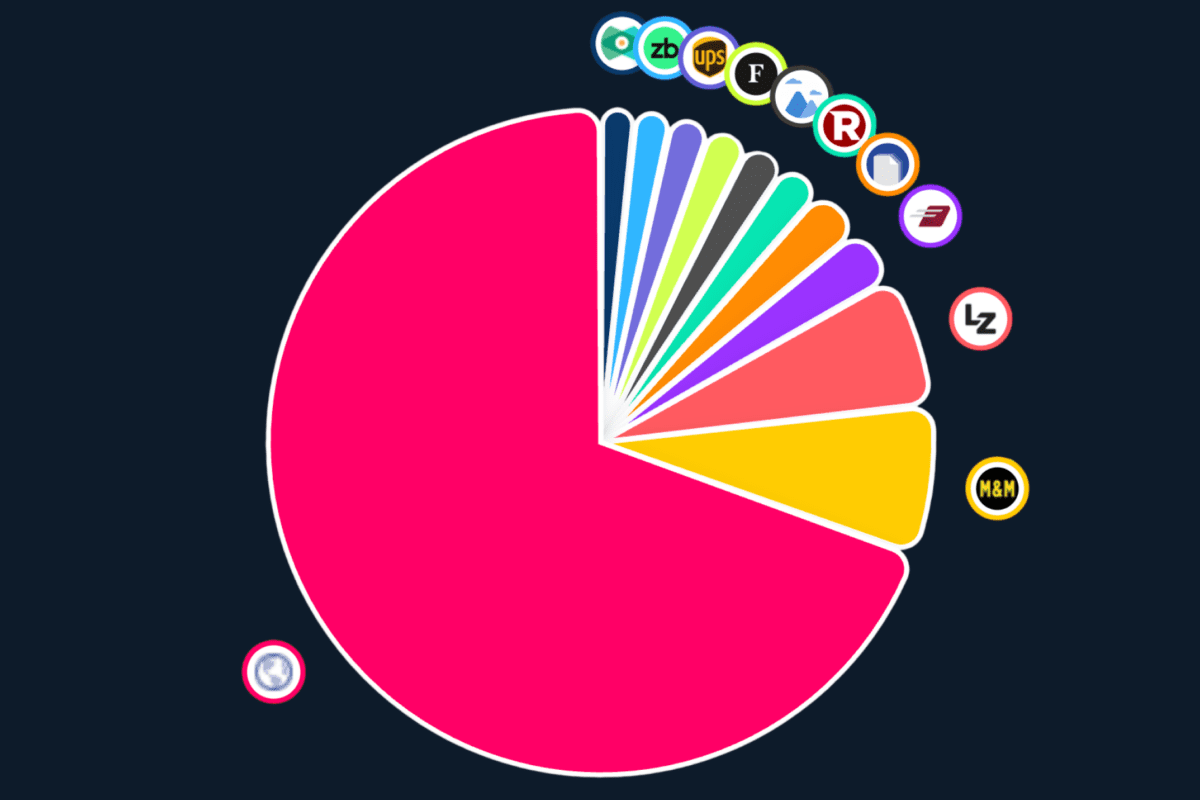
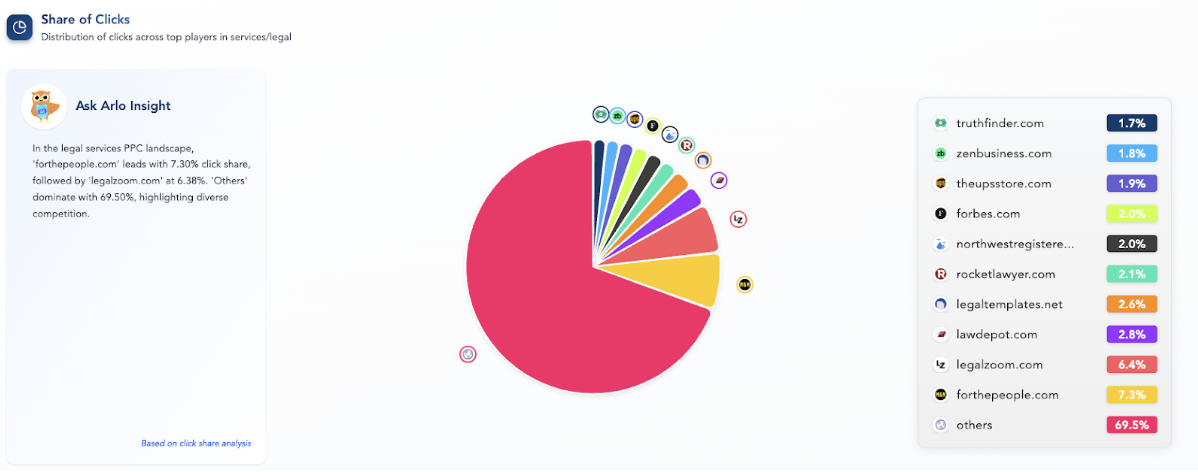
According to Adthena’s January 2026 data, while giants like Morgan & Morgan (8.4% click share) and LegalZoom (6.38% click share) dominate headlines, a massive 67.5% of the market is held by “Others.” These are the “Shadow Bidders” – regional firms and niche aggregators that bid on your brand terms, riding your multi-million dollar TV awareness to steal the final, high-intent click. Without total brand protection, you are effectively subsidizing your competitors’ lead generation.
The rise of the "Complex Query" & AI Overviews
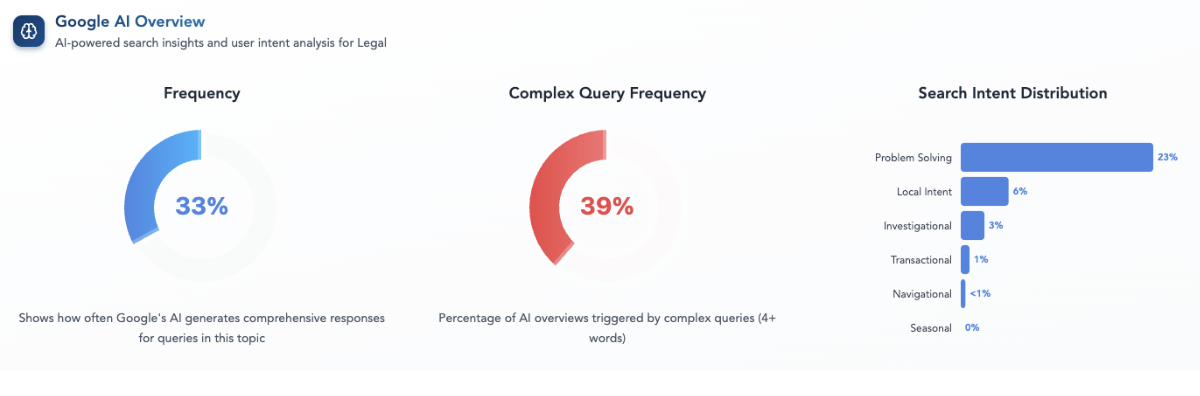
The way people search for legal help has fundamentally shifted. 50% of legal queries are now “complex” long-tail, multi-part questions that legacy keyword bidding misses.
Furthermore, AI Overviews (AIOs) now appear in 31-33% of searches. While the data shows that AIOs are currently neutral toward ad CTR, they are shrinking the above-the-fold real estate. If your ads aren’t optimized for these complex, problem solving journeys, you risk disappearing into the scroll zone.
Industry deep dive: 5 pillars of 2026 search sovereignty
Mastering search in 2026 requires a category-first approach. Just as global leaders manage high-performance product lines as independent businesses, your firm must treat each practice area as its own distinct search universe.
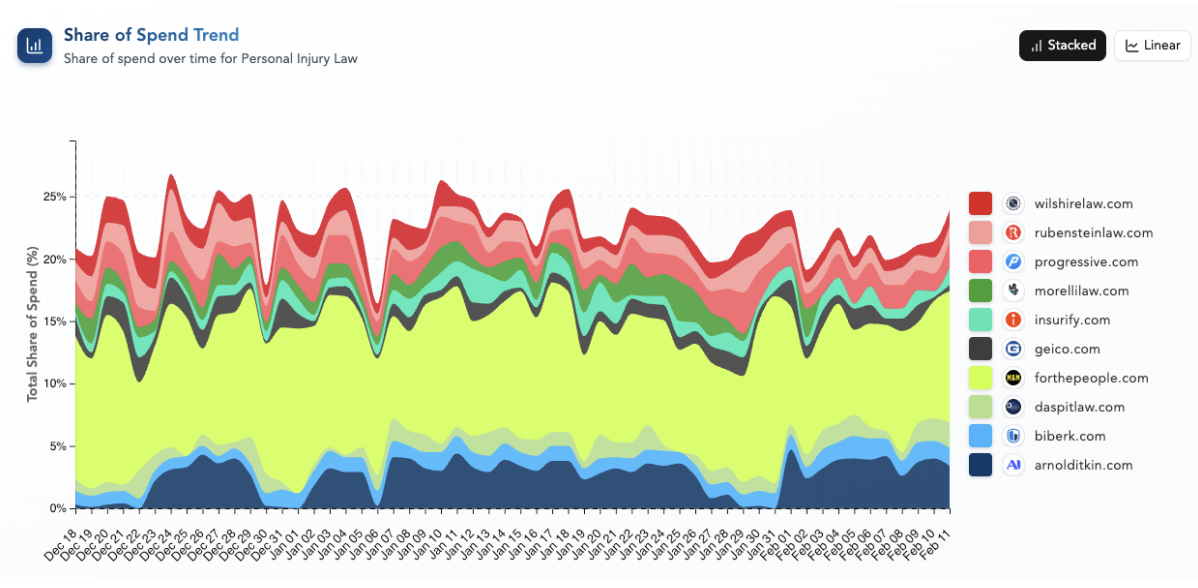
Personal Injury is the most volatile sector in US search, with 4,000+ domains competing daily.
The trend: Success is defined by “Mobile-First” discovery, which peaks at over 4,600 active advertisers during month-end surges.
The strategy: Split your creative. Use “Comparison-intent” (e.g “Compare rates in 5 mins”) to fight off insurers, and “Outcome-intent” (e.g “Billions recovered”) to build PI trust.
2. Business formation: The brand sovereignty race
This is the high-transaction territory
The trend: We see massive surges in “Transparent ownership” queries due to new 2026 federal regulations.
The strategy:
Adthena’s Infringement Tracker: Use this to identify where competitors are illegally using your trademarked brand name in their ad copy to intercept entrepreneurs.
Adthena’s Brand Activator: Automatically pause your bids on terms where you already rank #1 organically and no one is bidding against you.
The creative shift: Transition your messaging from “How to” (which AI provides for free) to “Certainty & Liability” – reminding users that while AI can give information, only your firm can provide the legal protection they actually need.
3. Family Law: The local authority factor
The trend: Users are fleeing generalist finance sites for category-native experts. Brands like FindLaw and Atticus are gaining ground as users seek specialist authority over general advice.
The strategy: Use Adthena’s Local View to win block-by-block. National strategy will bleed budget here; you must dominate high-income geo-pockets where boutique competitors currently hide.
4. Intellectual Property: The complex frontier
The trend: IP law attracts the most technical questions. 50% of queries are complex, such as “Does AI-generated code qualify for trade secret protection under 2026 standards?”
The strategy: AIO double-dipping. Optimize your content to be the cited authority in AI summaries. When your firm is the source in the AIO, your paid ad below it sees a significant trust multiplier.
5. Labor & Employment: The AI compliance shockwave
2026 has introduced a new brand of litigation: The Algorithmic Dispute.
The trend: Counter-cyclical demand for Labor & Employment has surged 3.3% year-over-year. New state-level AI labor laws (targeting algorithmic bias and transparency) have created a “Compliance Gap” in search.
The strategy: Don’t just bid on “labor lawyer.” Target the 46% of complex queries asked by HR directors regarding AI transparency audits. Being the first to answer these regulatory questions captures the highest-value corporate leads before they reach an RFP.
Reclaiming your search sovereignty
Winning in 2026 isn’t about the biggest budget; it’s about the clearest vision. To protect your margins, you must:
Own high-intent micro-moments: Prioritize mobile-first formats and 24/7 click-to-call for “incident + location” queries.
AIO defense: Optimize your “Knowledge Hub” to be the cited source in AI summaries, ensuring your firm remains the authority even when Google provides the answer.
Efficiency via automation: Use tools like Adthena’s Brand Activator to stop bidding on your own name when you already dominate organically, reallocating those dollars to “white space” opportunities.