Ads in AI search: Key takeaways from the front line

Adthena was the first to spot ads appearing in AI search across both Google's AI Overviews and ChatGPT. Here's everything we've learned so far.

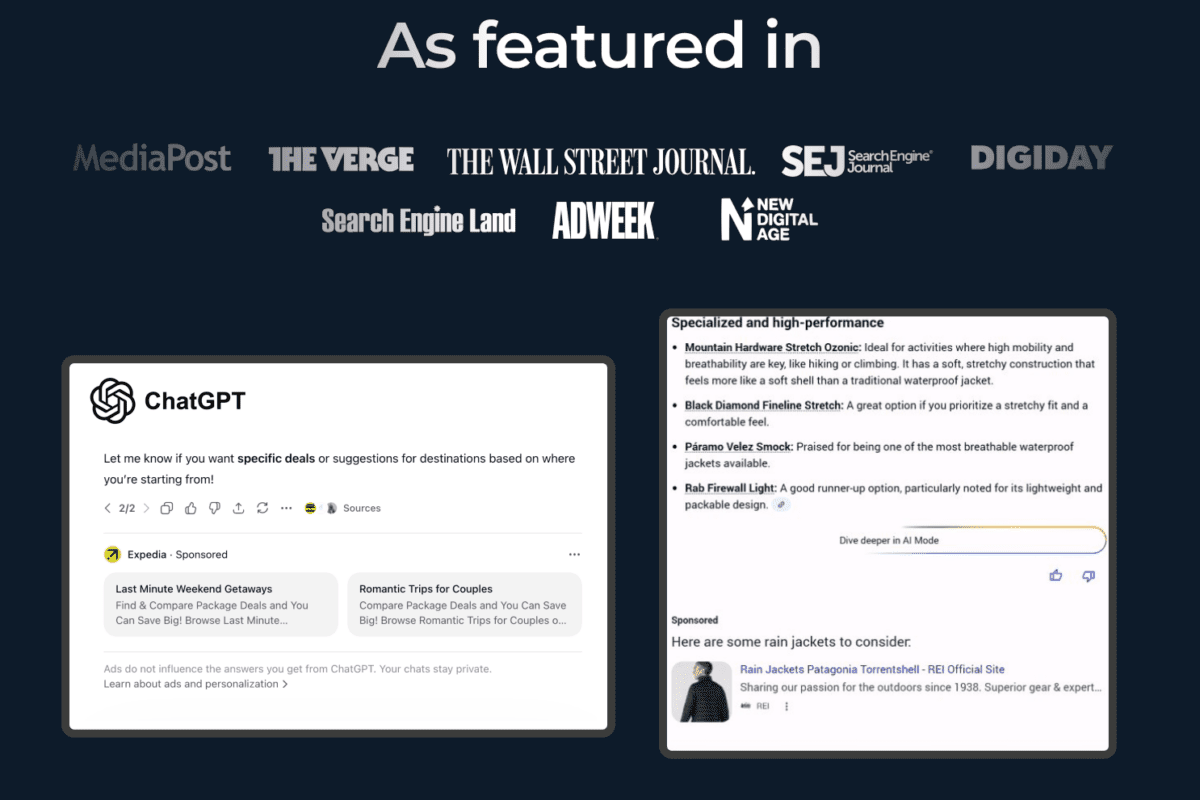
Adthena in the press

TL;DR

Ads are now live in both Google’s AI Overviews and ChatGPT. CTRs are being squeezed, CPMs are high, and the first movers are already pulling ahead. Adthena has been tracking it all from day one, here’s the data.


Adthena in the press image
Published by Serra Hale March 31, 2026

From the first ads inside Google’s AI Overviews to sponsored placements on ChatGPT, the last few months have rewritten the rules of ads in AI search. Here’s what happened, what the data shows, and why it matters for every advertiser running campaigns right now.

If you work in paid search, the last few months have felt like a decade. Two of the biggest shifts in the history of digital advertising happened almost back to back – ads landed inside Google’s AI Overviews, and then ads went live inside ChatGPT. Both events were predicted. But the speed, the format, and the real-world impact? Nobody had the full picture until the data started rolling in.

At Adthena, we didn’t just watch these changes happen. We were the first to spot them, document them, and get the story out to the media outlets and marketers who needed to understand what was really going on. This post pulls together everything we’ve learned, what the industry is still figuring out, and about the emerging world of ads in AI search.

Ads enter Google's AI Overviews and Adthena catches it first

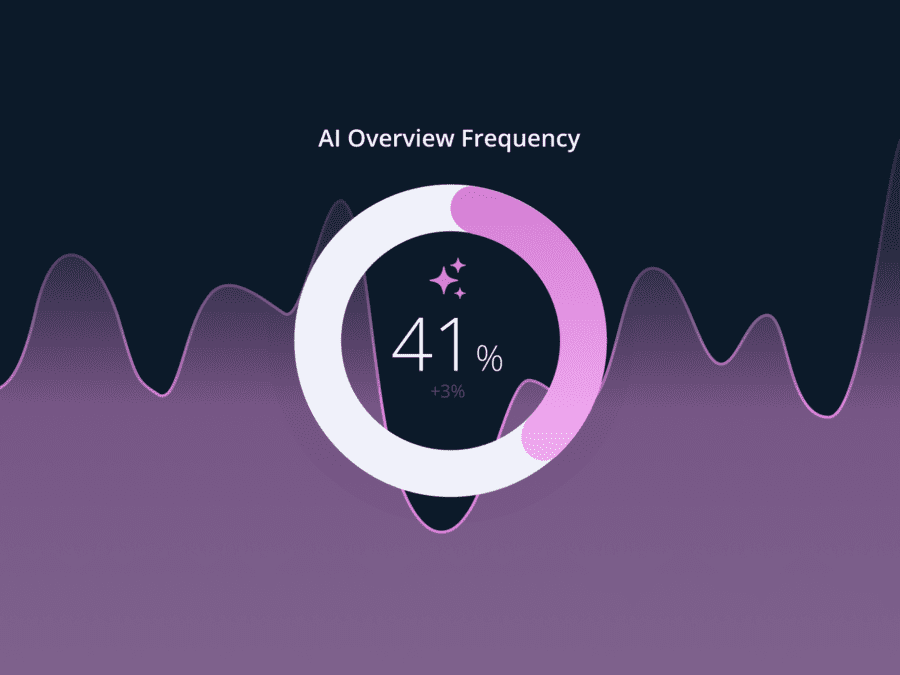
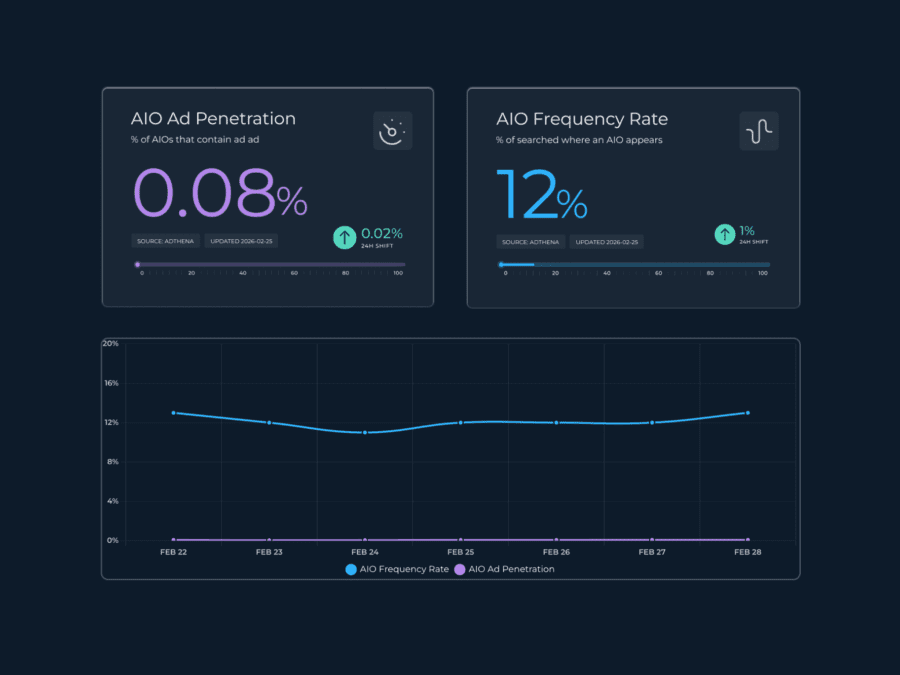
It started with 25,000 searches and 13 ads. On November 25, 2025, Adthena became the first platform in the industry to detect ads appearing inside Google’s AI Overview search results. A 0.052% ad frequency that, on the surface sounds tiny, but what it represented was enormous.

“This is a pivotal moment for search marketers. For the first time, we can see ads entering AI-generated results. Our mission is to answer the questions that paid search marketers have — as ads enter AIOs, a new set of questions emerge and we’ll be able to provide answers on frequency, which brands appear (and don’t), and the impact these ads have on overall campaigns. We strive to give brands clarity in every new search environment — and today, that extends to the emerging world of ads in AI Search.”

— Phillip Thune, CEO, Adthena

The detection was covered by Performance Marketing World and PPC Land, and picked up across the search marketing community. Adthena was able to share what the first ads looked like, spotted on desktop in the US they appeared similar to traditional Google text ads (blue headline, short description, thumbnail image, and a “Sponsored” label) but placed directly beneath the AI Overview summary. A new format for a new era.

But the bigger story wasn’t the format. It was the financial pressure underneath it. Adthena’s own research, drawn from 21 million search indexes across five key industries, had already shown that paid search CTRs could drop by 8–12 percentage points (a 20–40% relative decline) as AI-generated answers take up more SERP real estate. Ads inside AIOs were Google’s answer to that revenue problem. And now they were real.

Adthena CMO Ashley Fletcher told New Digital Age: “Ads appearing on AI Overviews is a pivotal moment in paid search because AIOs fundamentally change where attention goes on the SERP. For the first time, paid ads aren’t just competing with other ads or organic listings — they’re competing with Google’s own AI-generated answer.”

The AIO Impact data: What six industries told us

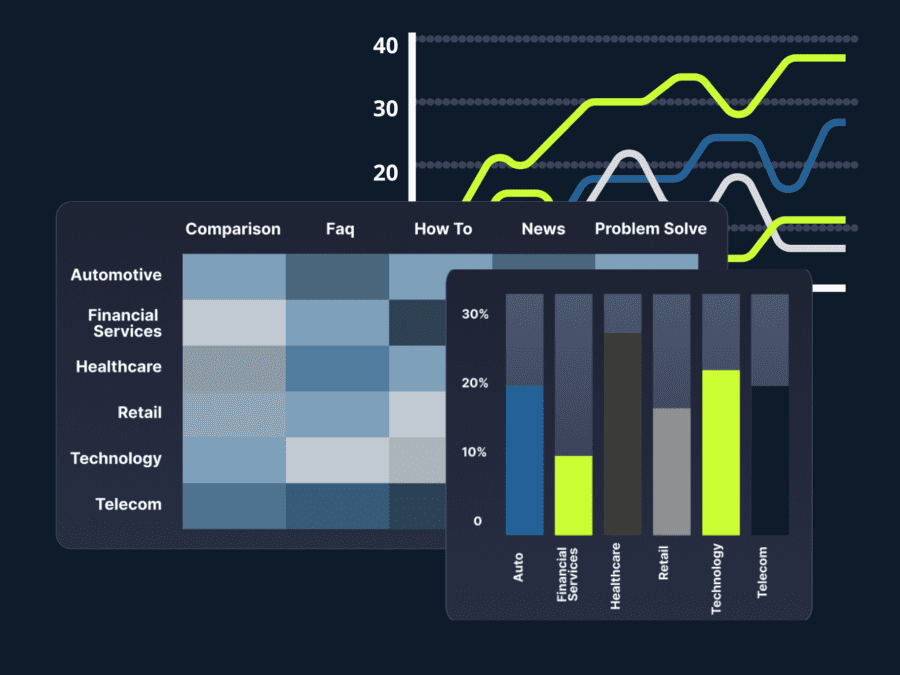
By February 2026, Adthena’s data science team had analyzed performance metrics from hundreds of thousands of advertisers – more than 5 million ads across six major industries. The findings were published in Search Engine Land under the headline “What industry data reveals about the impact of Google’s AI Overviews on paid search.”

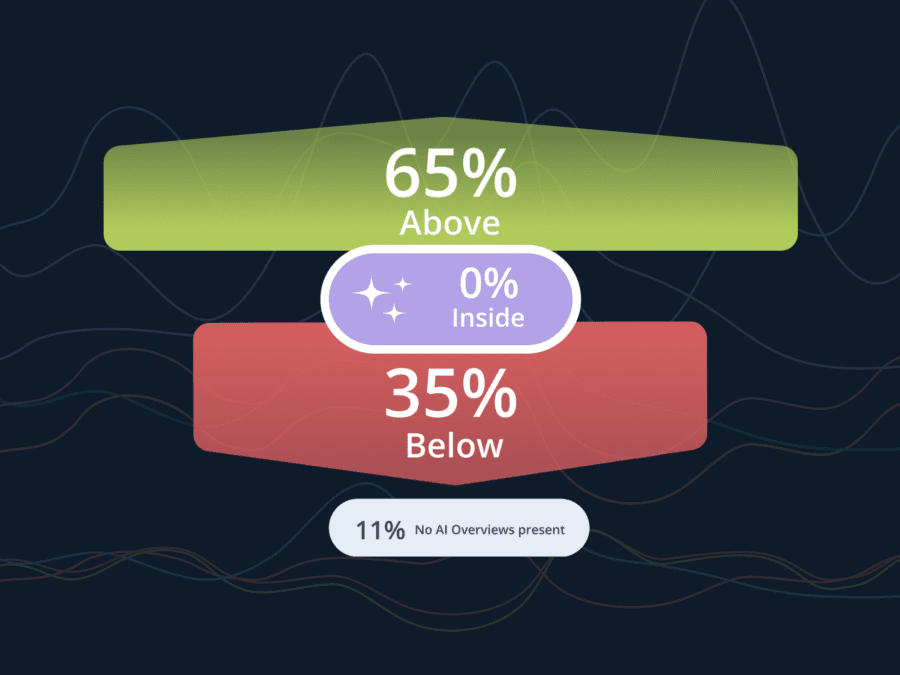
The headline finding: aggregate data looks stable. The real picture doesn’t. Across six industries, one in four paid ads is impacted by AI Overviews. In healthcare, ads appear below AI Overviews roughly 64.6% of the time. On mobile, impressions for top ads dropped by 20% or more. The “visibility tax”, that is advertisers paying higher CPCs just to stay above the fold, is now a real line item for anyone tracking ads in AI search.

Key data points from Adthena’s AIO analysis

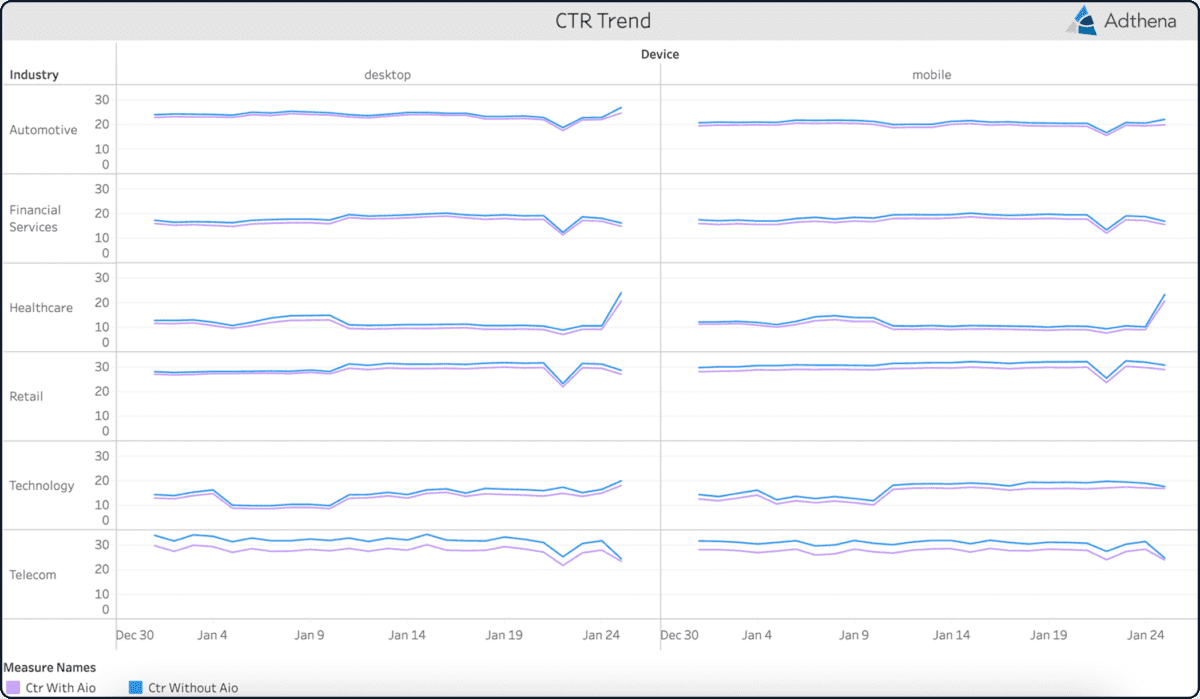
  • Paid CTRs decline 8–12 percentage points (20–40% relative drop) when AIOs appear
  • 1 in 4 paid ads across seven industries is impacted by AI Overviews
  • Healthcare ads appear below AI Overviews 64.6% of the time
  • Brands cited in AIOs see 91% higher paid CTR (7.89% vs 4.14% for non-cited brands)
  • Mobile impressions for top ads dropped 20%+ due to compressed SERP real estate

Adthena data showing AIO impact across CTR trends

Adthena also published a follow-up piece in Search Engine Land: “4 strategic paid search pivots to survive Google’s AI Overviews”, giving marketers a concrete playbook for adapting. The message was clear: this isn’t a future problem. It’s a problem now.

ChatGPT gets ads and the industry holds its breath

On January 16, 2026, OpenAI announced it would begin testing ads inside ChatGPT for free and Go-tier users in the US. The move reversed years of public skepticism from CEO Sam Altman, who had called advertising a “last resort.” The financial reality of burning through billions while only 5% of 800 million weekly users pay for subscriptions, made the decision inevitable.

What followed was a cascade of media coverage, speculation, and strategic positioning. Adthena was right in the middle of it.

AdWeek broke the exclusive that OpenAI was asking select advertisers to commit at least $200,000 to participate in the early beta, with some brands approached at $250,000. Adthena confirmed that four of its clients had been approached with those minimum thresholds. The CPM was set at approximately $60, three times Meta’s average rates and comparable to premium video inventory.

“OpenAI is starting with a curated, and conservative approach to ad frequency. That scarcity could also signal how OpenAI is positioning early access to advertisers, working with a curated mix of enterprise brands and select partners as it shapes its ad offering.”

— Adthena, as quoted in AdWeek

Holding companies lined up fast. WPP, Omnicom, and Dentsu all signed on as launch partners, bringing brands like Adobe, Ford, Mazda, Audible, and Audemars Piguet into early experiments. OpenAI went direct to brands, not agencies – a deliberate signal about how it wanted to shape the early advertiser experience.

Target’s retail media business, Roundel, was among the first to test. As reported across multiple outlets, Roundel’s position, with 2,000+ vendors and roughly $2 billion in annual value, made it a natural fit for a platform looking to prove commercial intent at scale.
Adthena spots the first live ChatGPT ads before anyone else

Ads went live on February 9, 2026. Within days, Adthena’s team was running prompts. Hundreds of them. And on February 18, Ashley Fletcher, Adthena’s CMO, posted to LinkedIn what would become one of the most-shared moments in search marketing that month: the first confirmed screenshot of a live ChatGPT ad in the wild.

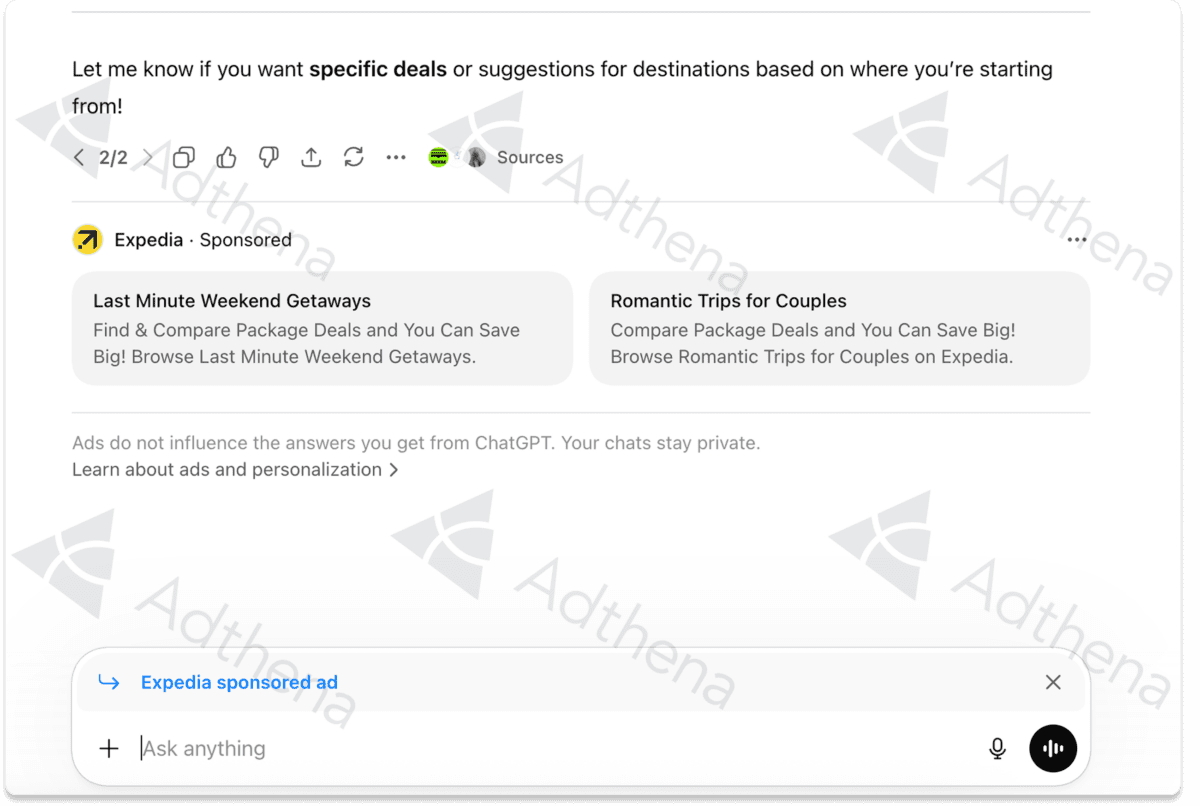
The ad was from Expedia. The prompt? “What’s the best way to book a weekend away?” No back and forth. No second message. The sponsored placement appeared on the very first response, immediately challenging the industry assumption that ChatGPT ads would only show up after extended conversational turns.

Chatgpt ads trial showing an Expedia ad

Search Engine Land ran the story under the headline “ChatGPT ads spotted and they are quite aggressive”, citing Adthena’s discovery and noting that the immediacy of the ad trigger suggested OpenAI was treating single, high-intent prompts as viable ad inventory from day one. The Verge also picked up the story, reporting that “Adthena, an ‘AI search intelligence’ platform, has spotted ads in ChatGPT, and they can apparently trigger as soon as after your first prompt.”

AdWeek then published the definitive piece: “Best Buy, Expedia, Enterprise Mobility Are Among the First Brands Spotted Running Ads on ChatGPT.” The story was built directly on Adthena’s analysis of more than 500 ChatGPT prompts, which found ads appearing in roughly 0.8% of responses, confirming that OpenAI was keeping frequency deliberately low while it figured out what worked.

First confirmed live advertisers on ChatGPT (Adthena analysis, Feb 20, 2026)

  • Expedia — travel discovery query triggered immediate first-prompt ad placement
  • Best Buy — independently confirmed participation with AdWeek; secured two ad placements in a single iPhone-related response
  • Enterprise Mobility — independently confirmed participation with AdWeek
  • Qualcomm — confirmed in Adthena data
  • The Knot Worldwide — confirmed in Adthena data
  • Pottery Barn — spotted in expanded analysis, covered by Performance Marketing World
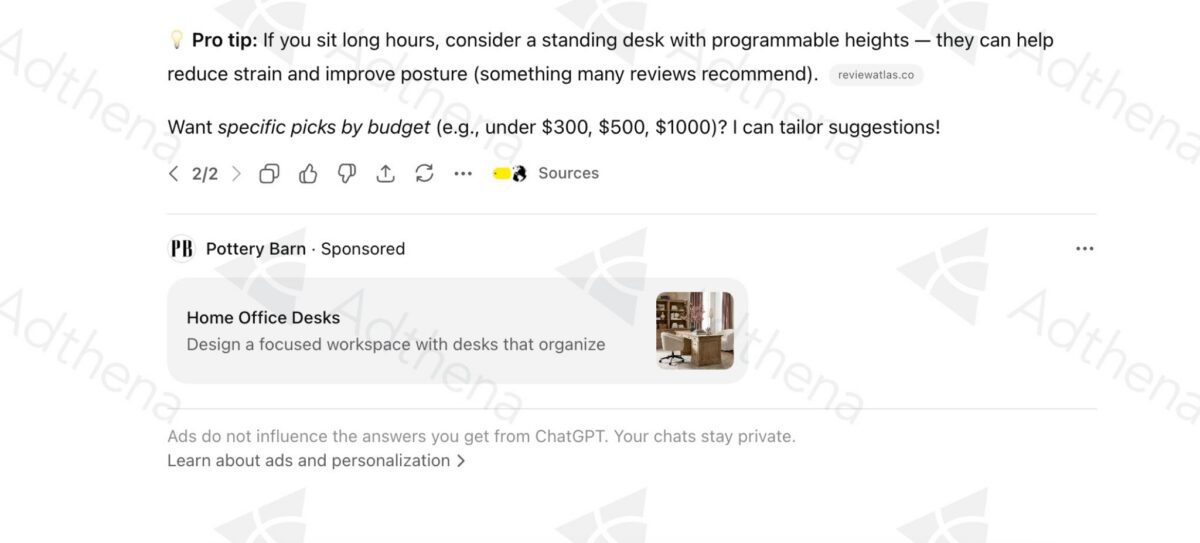
chatgpt ads trial showing a Pottery barn ad

The story keeps moving

Adthena didn’t stop at the first sighting. After analyzing over 1,500 prompts, the team published a deeper breakdown of how ChatGPT ads were triggering and the patterns were clearer than expected. Keywords like “best” and “new” were driving commercial intent. Simple prompts like “I need a new phone” and “What’s the best desk?” were enough to fire ads. Best Buy was already experimenting with share of voice, landing two placements in a single response.

Search Engine Land covered the expanded findings in “ChatGPT ads expand as more brands and trigger patterns emerge,” citing Adthena CMO Ashley Fletcher’s LinkedIn posts as the primary source. Performance Marketing World ran “First ChatGPT advertisers spotted: Best Buy, Pottery Barn and Expedia”, again drawing directly on Adthena’s prompt analysis.

On March 2, 2026, Criteo became the first ad tech company to formally integrate with OpenAI’s advertising pilot, a move that signals the infrastructure layer is being built out fast. And on February 11, Google announced shopping ads inside AI Mode, doubling down on conversational commerce as its own answer to the ChatGPT threat. AI Mode had already reached 75 million daily active users. The ad formats were clearly labeled as sponsored and designed to surface retailers at key moments of discovery.

“ChatGPT’s ad era has quietly begun. For marketers, the question is no longer if they need an AI search strategy — it’s whether they’re already late.”

— Search Engine Land, citing Adthena’s findings

Adthena was also recognized in a broader industry roundup in AdWeek, “From Adthena to Profound: These 6 Hot GEO Startups Are Shaping the Future of AI Shopping” as one of the platforms actively building the intelligence layer that brands will need to compete in this new environment.

What this all means for paid search right now

The walls between paid and organic search are coming down. As brands respond to AI search, the distinction between a sponsored placement and an organic citation is blurring inside Google’s AIOs, inside ChatGPT, and inside Google’s AI Mode. The question isn’t which channel wins. It’s how you show up across all of them.

Here’s what the last few months have confirmed:

  1. AI Overviews are a current revenue threat. Adthena data shows real CTR erosion, varying by industry and device; brands must track it.
  2. ChatGPT ads are live, conservative, and expensive. With a $200K minimum and $60 CPM, this is currently enterprise-only, but high-intent triggers are simple, and first movers are learning fast.
  3. Prompt-level triggers are the new keyword battle. Terms like “best” and “new” drive ChatGPT ad delivery. Competitive intelligence now requires understanding competitor prompt placement.
  4. Google is actively responding. Features like Shopping ads in AI Mode, Direct Offers, and the Universal Commerce Protocol show Google is rebuilding the SERP around AI, requiring paid search strategies to adapt.
  5. Visibility data is now essential. Tracking AIO frequency, monitoring ChatGPT ad placements, and benchmarking competitor activity across new AI surfaces is critical for brands to win.

What's coming next: Our deepest AI Search analysis yet

The pace of change hasn’t slowed and neither has Adthena’s research. Our upcoming AI Search Ads: The Advertiser Intelligence Report goes deeper than anything we’ve published before, drawing on 29.1 million queries across 10+ industries and three markets to map exactly how the AI ad landscape is taking shape.

From which queries actually trigger AI ads (the answer will surprise you) to CTA language that drives a 35% CTR uplift, competitive winners by vertical, and a full breakdown of the ChatGPT ad landscape. It’s the most comprehensive guide to AI search advertising available anywhere.

The full report is coming soon. Watch this space.

AI Search Ads: The Advertiser Intelligence report | Adthena

If you want to understand how AI search is impacting your campaigns right now and what to do about it, get in touch: book a demo today.

Related content