TL;DR
Two years ago, our customers typed keywords into Arlo. Today they write briefs. Prompts are 92% longer, context-setting has increased 12 times over, and multi-turn follow-ups went from near zero to 11%. Here’s what changed, why it matters, and what it means for your team.

Published by Serra Benstead
May 28, 2026
When Agent Arlo launched, it met a customer base that’s been practicing with AI for two years. And the data shows it. Prompts that used to look like search queries now look like analyst briefs. The shift didn’t happen overnight, but it’s measurable across every behavioral dimension we track.
Here’s what the numbers show, what drives them, and how your team can use it.
From search box to briefing room
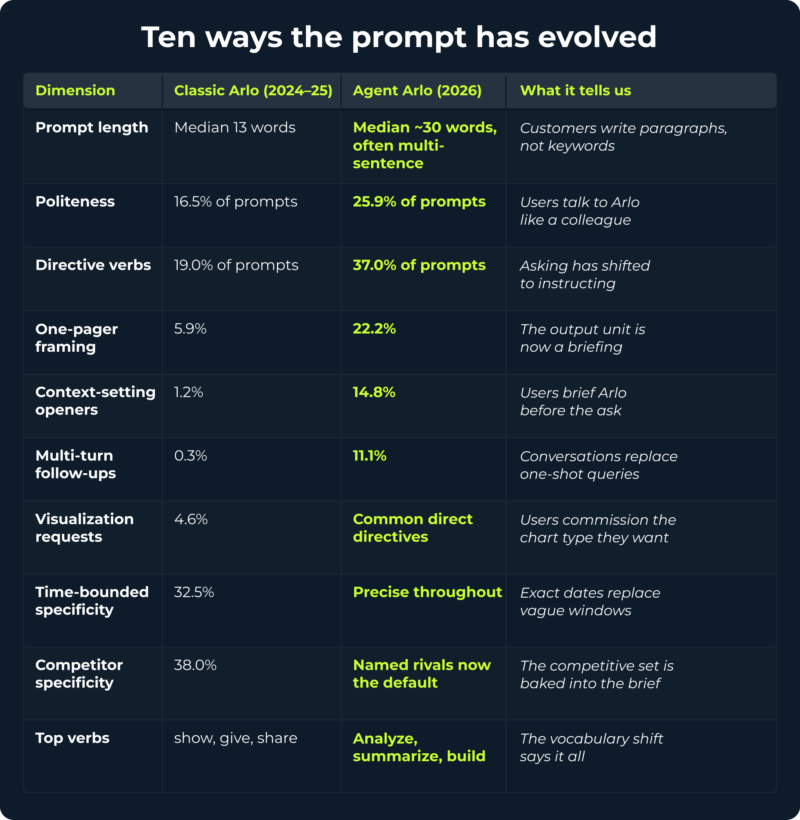
In 2024, the median Arlo prompt was 13 words. By the first week of Agent Arlo it had hit 30, often across multiple sentences. That’s not padding. It’s context. The kind of framing a good manager gives before delegating: here’s the situation, here’s what matters, here’s what I need.
A prompt like this is now common:
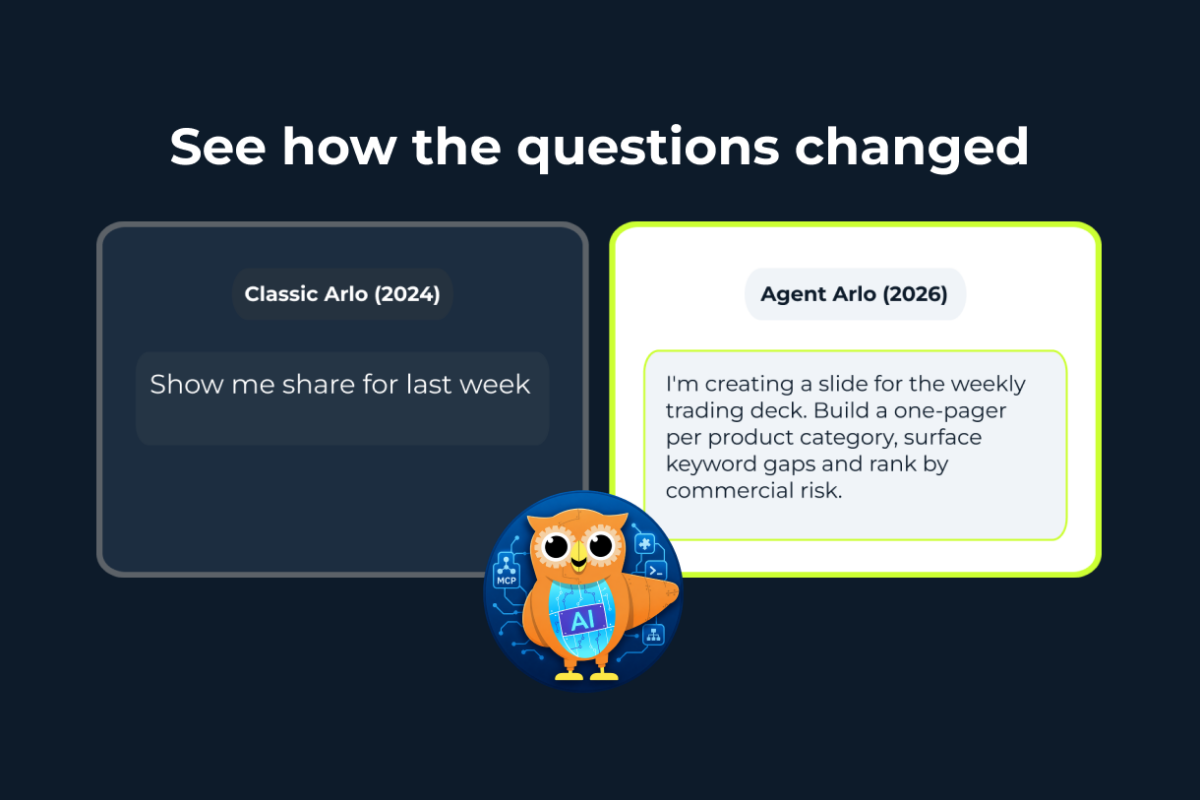
“I’m creating a slide for the weekly Trading deck. Build a one-pager per product category, surface keyword gaps and rank by commercial risk. Now run that again with only my terms.”
That’s brief; the person writing it knows what they want, knows what format they need it in, and they’re treating Arlo like a capable colleague. Not a data retrieval tool.
What does the vocabulary tell us?
In 2024, the most common verbs in Arlo prompts were show, give, share, copy and provide. The vocabulary of someone asking a dashboard to surface data they’d then interpret themselves.
By 2026, those verbs have been replaced by analyze, summarize, build, visualize and compare. Users aren’t asking to see data anymore. They’re asking for the thinking to arrive already done.
The colleague effect
In 2024, 16.5% of prompts included conversational or polite language. By 2026 that figure is 25.9%.
People say please to colleagues. They don’t say please to dashboards. The rise in polite framing reflects a mental model shift that shows up consistently across the dataset. Customers are treating Arlo like a working relationship, not a query interface. And it’s producing better outputs as a result.
Context-setting: the biggest leap
The single most striking shift in the dataset is in context-setting openers. Prompts that begin by establishing business context before making a request went from 1.2% in 2024 to 14.8% in 2026. A 12x increase in one year.
What does that look like in practice?
Classic Arlo: “share last week?”
Agent Arlo: “Yesterday we had a good sales day for AMI and State. For context …,” “I’ve been asked to provide a view of competitors in…”
The second prompt isn’t longer for the sake of it. The context makes the output more useful. And customers have learned that, because they’ve seen what happens when you brief Arlo properly.
Multi-turn follow-ups: a new behavior entirely
Multi-turn follow-ups were essentially absent from Classic Arlo. They accounted for 0.3% of interactions. In the first week of Agent Arlo: 11.1%.
This is what working with a good analyst feels like. You get an answer, you push on a thread, you ask the follow-up. The conversation builds. The insight deepens. Agent Arlo supports that workflow where Classic Arlo couldn’t.
Deliverables, not data
One in four prompts to Agent Arlo now asks for a synthesized, shareable output: a one-pager, a dashboard, a CMO-ready summary. That figure was 5.9% in 2024.
Customers have figured out that the output isn’t raw data to interpret. It’s a finished product. And Agent Arlo can build the format that tells the story best — whether that’s a Sankey diagram, a treemap or a slide-ready briefing. But only if you ask for it.
So what does this mean for your team right now?
Brief it like you’d brief a person
The teams seeing the best results aren’t typing keywords. They’re writing briefs: who’s asking, what decision does this inform, what format does the output need to be in. More context means more useful output. Every time.
Use follow-up prompts. They compound
If the first answer surfaces something interesting, push on it. Ask Arlo to go deeper on a particular competitor, explain what’s driving a trend, or reframe for a different audience. The second and third questions are often where the real insight lives.
Ask for a deliverable
If you’re going to present something, ask for something presentation-ready. Agent Arlo can build dashboards, one-pagers and executive summaries. It just needs to know that’s what you want.
Name your competitors specifically
“Top competitors” is a search term. “Trade Me versus Seek, Jora and Adzuna in Shopping results for junior developer” is a brief. The more specific the competitive set, the more useful the comparison.
Set it on a schedule
Recurring analysis can be delivered directly to your inbox. The briefing that used to take hours arrives already done.
The proof is in the prompts
Two years ago, we made a bet: that customers, given the right AI analyst, would learn to brief it well. Not immediately. But over time, with better outputs reinforcing better prompts.
The data confirms it. The customers who started with “show me share for last week” are now writing multi-paragraph briefs with named competitors, specific date ranges and business context built in. They’re not using a better search box. They’re working with an analyst. And they’ve learned how to get the most from that relationship.
Agent Arlo meets a customer base that two years of practice has trained to expect a colleague, not a query box. That’s not a small shift. That’s a fundamentally different way of working.
See Agent Arlo in action.