TL;DR
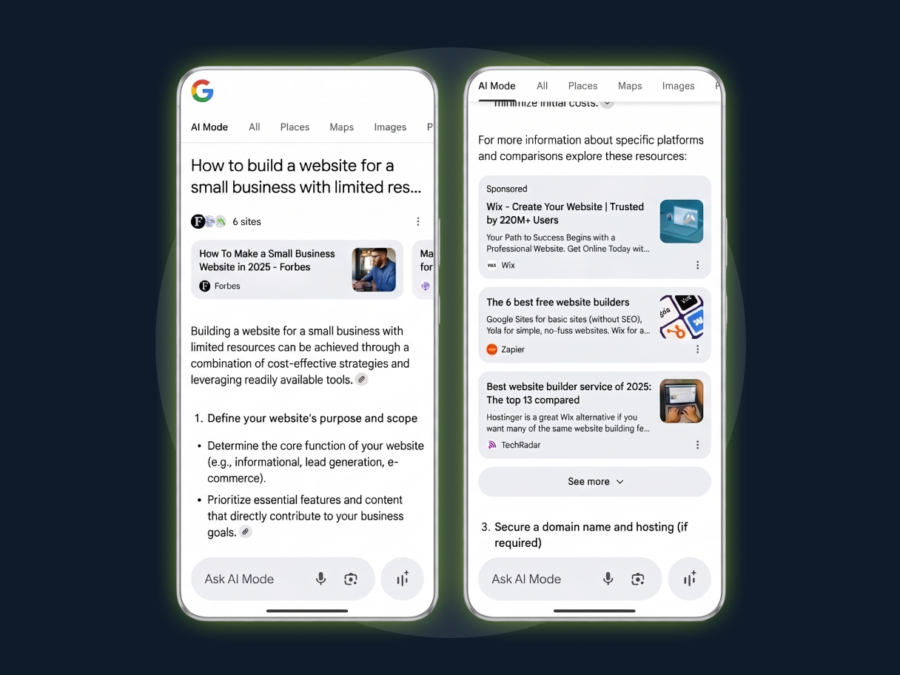
ChatGPT Ads and Google’s AI Mode look near-identical on the surface, but they operate very differently underneath. Across nearly 850,000 AI search queries, we found ChatGPT advertising remains concentrated in the US, shows a single ad where Google runs a carousel, and blocks regulated sectors such as legal and pharma that Google still serves. The common challenge: neither platform lets you see your competitors. (Note: this data predates the UK launch on 6 June)

Published by Sarah Mason
June 11, 2026
ChatGPT began serving ads to US users in February, and over the same stretch Google has been quietly slotting ads into its AI Overviews and AI Mode results.
The temptation is to treat them as the same thing, because side by side they really do look identical. In the US, ChatGPT serves ads on roughly 4.5% of queries, and Google’s AI surfaces sit just behind at 4.1%.
We analysed nearly 850,000 AI search queries across 20 industries and five markets between 14 March and 26 May 2026, before ChatGPT advertising launched in the UK. Five findings stood out, and together they cover most of what you need to know about how ChatGPT Ads behave today, and where they pull away from Google’s AI.
1. ChatGPT Ads are a US-first product, and effectively dark in the UK
Across our March-to-May data window, ChatGPT served ads on 4.47% of queries, and the US alone accounted for around 90% of every ChatGPT ad placement we recorded. Canada and New Zealand were already active at 4.57% and 3.85%, and Australia was warming up at 1.61%. The UK was the exception, because despite being our second-largest sample by volume at roughly 170,000 scrapes, it returned zero ads.
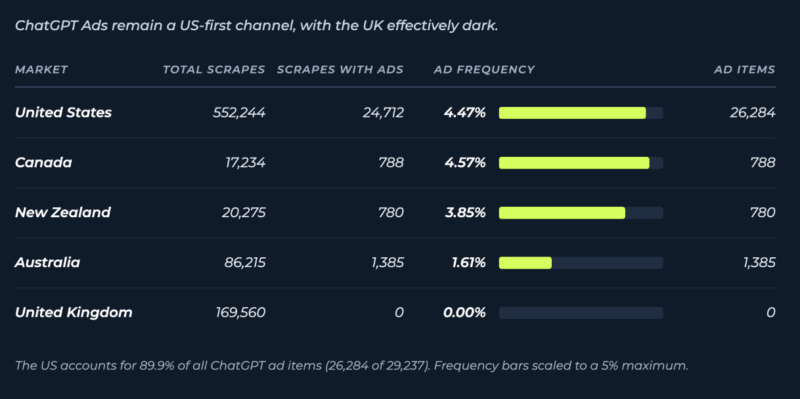
(Data captured 14 March–26 May 2026, before the UK pilot launched)
On 6 June 2026 OpenAI switched the ChatGPT ads pilot on in the UK, its first European market, and while it is early and gated for now (ads are showing to Free and Go users, and advertiser access is by registration rather than open self-serve), the channel is no longer dark here.
The blind spot used to be something UK teams could file under “prepare for later”, and it simply isn’t anymore. Your US competitors have already had months to learn which prompts convert and which creative works, so when UK buying opens up properly, they will not be starting from scratch even if you are.
2. ChatGPT shows a single ad in most cases. Google's AI shows a carousel
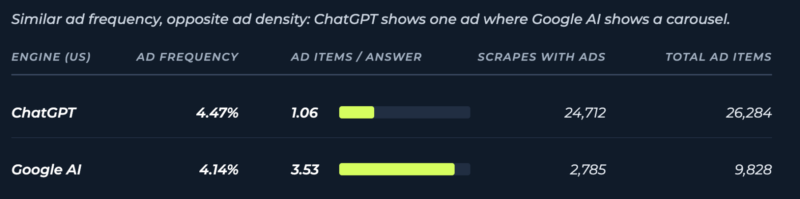
The US is the only market where we can compare both engines directly, and on ad frequency they’re nearly identical: ChatGPT 4.47% and Google’s AI 4.14%.
When ChatGPT shows an ad, it almost always shows exactly one, because the average ad-bearing answer carries just 1.06 ad items. There is no row of three and no shopping carousel, only a single sponsored slot in the large majority of cases. Google’s AI averages 3.53 items per ad-bearing answer, so it behaves much more like a carousel with room for several brands in the same response.
3. Regulated verticals are blocked on ChatGPT, but not on Google AI
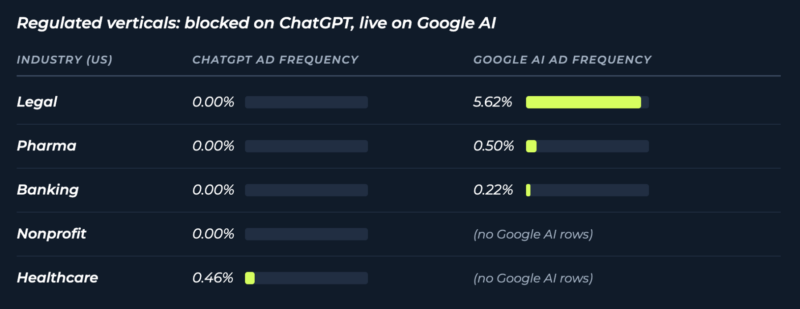
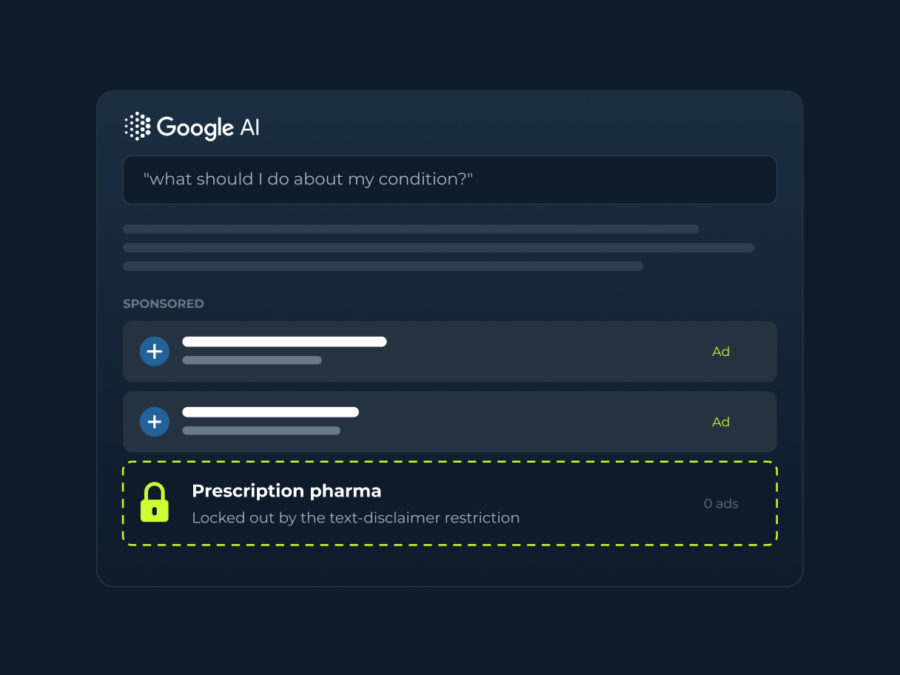
The two platforms have drawn their lines in different places, and you can see it most clearly in the regulated categories. Four industries returned zero ChatGPT ads across our entire dataset: Legal, Pharma, Banking and Nonprofit.
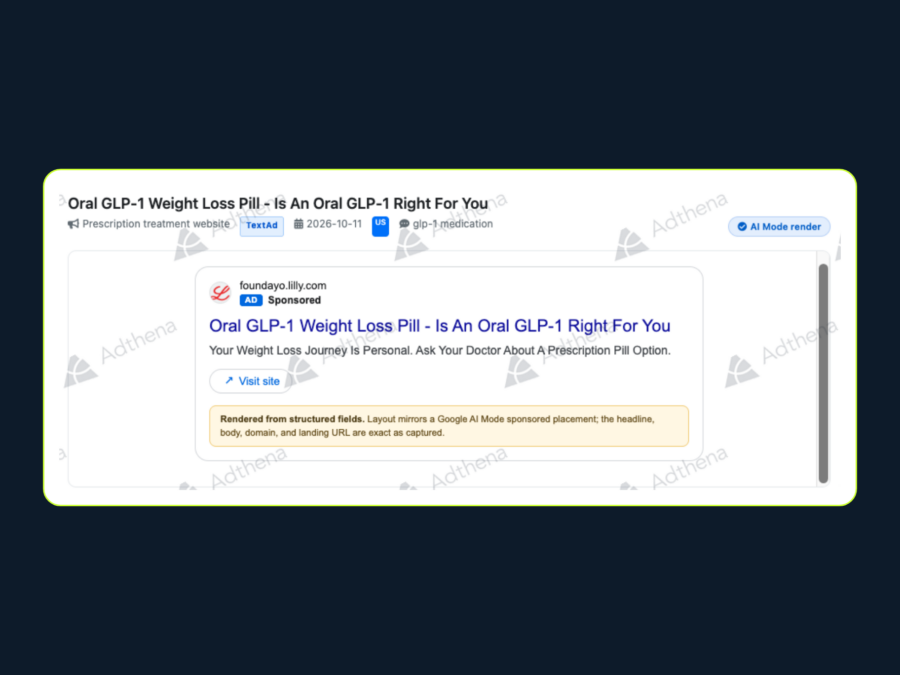
Healthcare was at 0.46%, so on ChatGPT these categories are effectively switched off. Google’s AI, by contrast, served ads in those same US verticals, with Legal running at 5.62% and both Pharma and Banking sitting low but still live rather than at zero.
The fact that Google serves ads where ChatGPT serves none indicates a deliberate policy decision on OpenAI’s side rather than an anomaly in demand or in our sample, and that matters for a practical reason: policy decisions change. The teams already monitoring these categories will know the moment a door opens, whereas everyone else tends to find out only once a competitor is already through it.
4. The hottest ad categories are Logistics, Home & Garden and Beauty
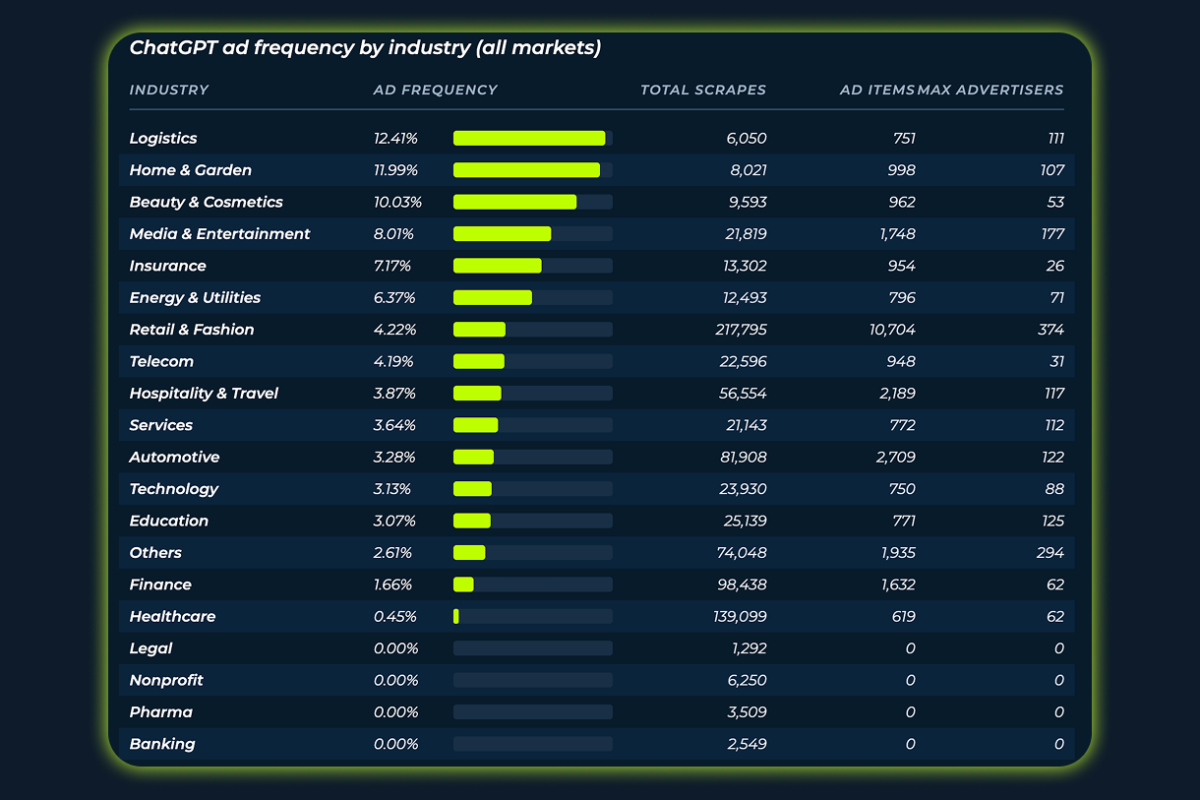
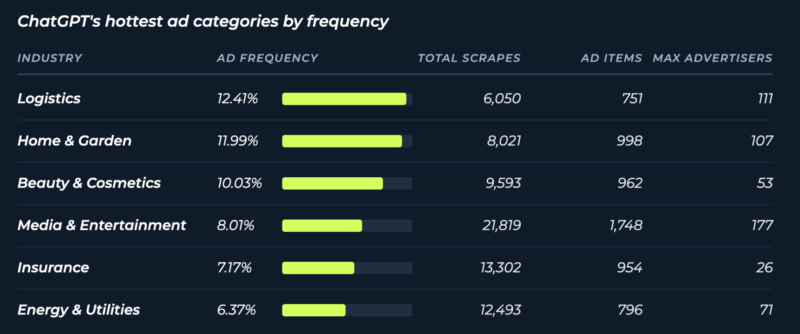
If you only keep an eye on the obvious commercial categories, you will miss where ChatGPT ad load is genuinely concentrating. The hottest verticals by ad frequency are:
- Logistics at 12.41%
- Home & Garden at 11.99%
- Beauty & Cosmetics at 10.03%
All of them running three to four times above the platform average of around 3.3%.
Media & Entertainment (8.01%), Insurance (7.17%), and Energy & Utilities (6.37%) sit a little way behind but are clearly building ground.
These are categories investing heavily into the channel right now, yet most of them aren’t the ones a search team would instinctively watch first. That gap, between where the spend is going and where attention is focused, is exactly the kind of detail competitive monitoring exists to catch.
5. Retail is the commercial centre of gravity
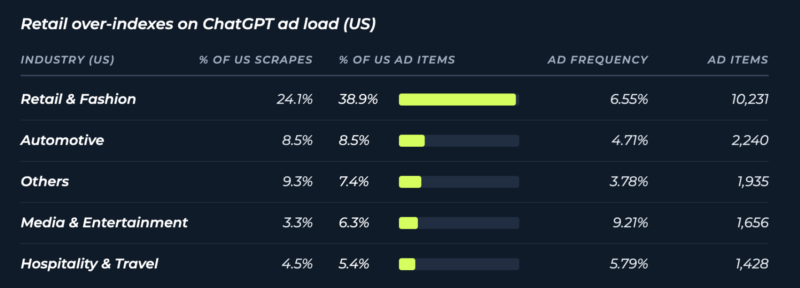
For all the movement in those hot verticals, the real centre of gravity is Retail & Fashion. It accounts for 24% of US query volume and a striking 39% of all US ad items, with an ad frequency of 6.55% against a US average of around 4.5%.
And it’s genuine advertiser demand, not just scrape volume – Healthcare was scraped just as heavily and produced a fraction of the ads.
More than a third of every ad placement in the dataset sits in this one category. If you sell anything in retail or fashion, this is already a contested channel, and the brands competing hardest for ChatGPT presence are doing it without being able to see one another.
So here's the actual problem
Every finding above leads back to the same uncomfortable place. You now have multiple AI ad channels where you can spend budget and see almost nothing of your competition.
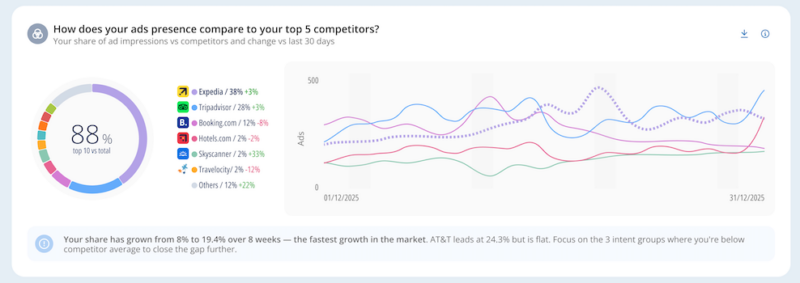
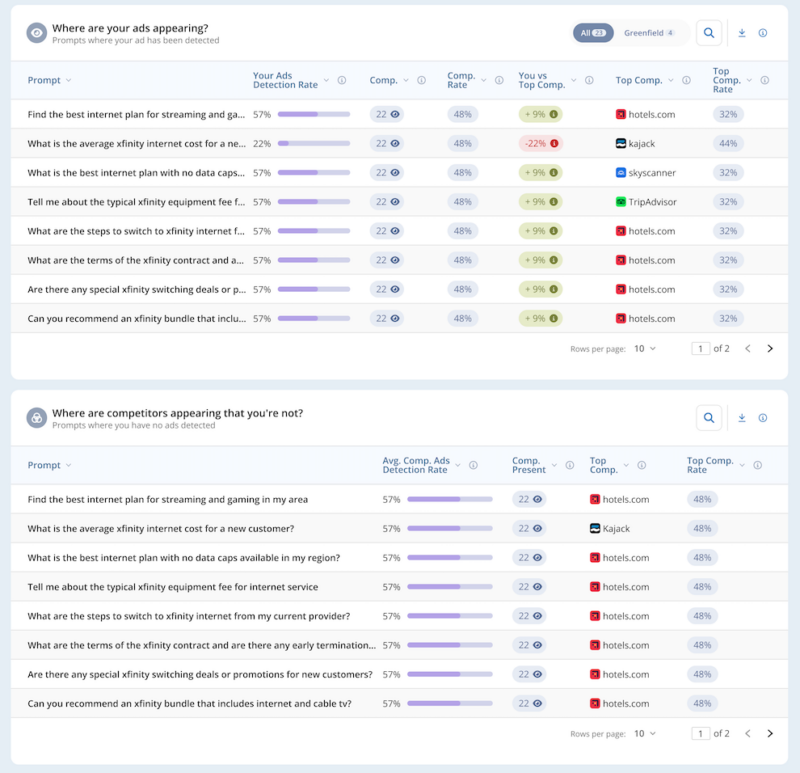
The native ad managers, ChatGPT’s and the AI placements inside Google alike, are built to show you your own performance: your spend, your impressions, your clicks, your CPC and your CTR. Even Google’s wider tooling only takes you so far. None of it gives you the whole-market view of who is bidding against you, which prompts are triggering their ads, what creative they are running, or where your share of search actually sits.
What full visibility looks like
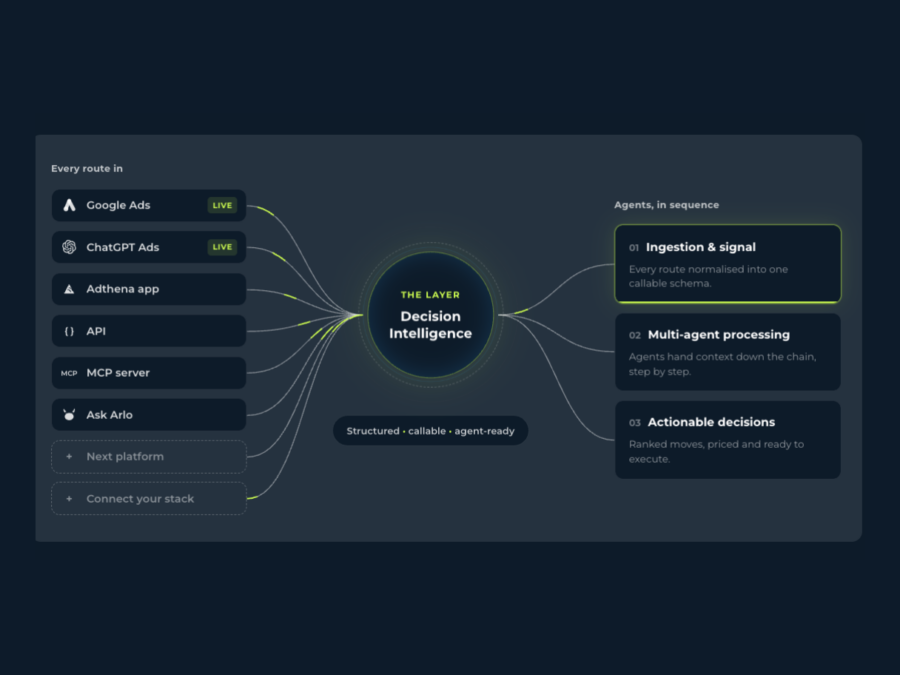
This is the gap Adthena was built to close. Our AI Search Intelligence gives you visibility across every surface where high-intent search is moving, so instead of only seeing your own numbers, you can see every competitor taking your share and where to win it back. It is the same approach that has made Adthena essential for Google paid search, now applied right across the AI search landscape.
That plays out across a connected set of tools:
- ChatGPT Ads Intelligence lets you see exactly who is advertising in ChatGPT and when, identify the conversational triggers your competitors are winning, and secure your position, monitoring 300,000+ prompts daily across the markets where ChatGPT Ads are live.
- ChatGPT AdBridge simplifies the process of launching search ads on ChatGPT by automatically converting your existing Google Ads campaigns into AI-optimized keyword lists and creative assets.
- AI Overview Impact helps you track and counter the AIOs that erode ad visibility, CTR, and campaign revenue.
- LLM Rank Tracking secures your brand’s presence in ChatGPT and Perplexity to win new AI-driven revenue.
Why this matters beyond ChatGPT
Search stopped being a single place quite a while ago. People now take their highest-intent questions (product recommendations, service comparisons, the what-should-I-actually-buy decisions) to ChatGPT and to Google’s AI answers, and as that intent has moved across, the ads have followed it.
The brands paying attention while these channels are still young will be the hardest to dislodge once they mature, and we have seen this before with Google Ads, where the early practitioners who understood the platform first built leads that took competitors years to close. That window is open right now, and our data shows it clearly.
Ready to see what’s really happening on ChatGPT Ads? Start your free 21-day trial of Adthena’s ChatGPT Ads Intelligence.