- Shopping ads run 57% longer than text ads
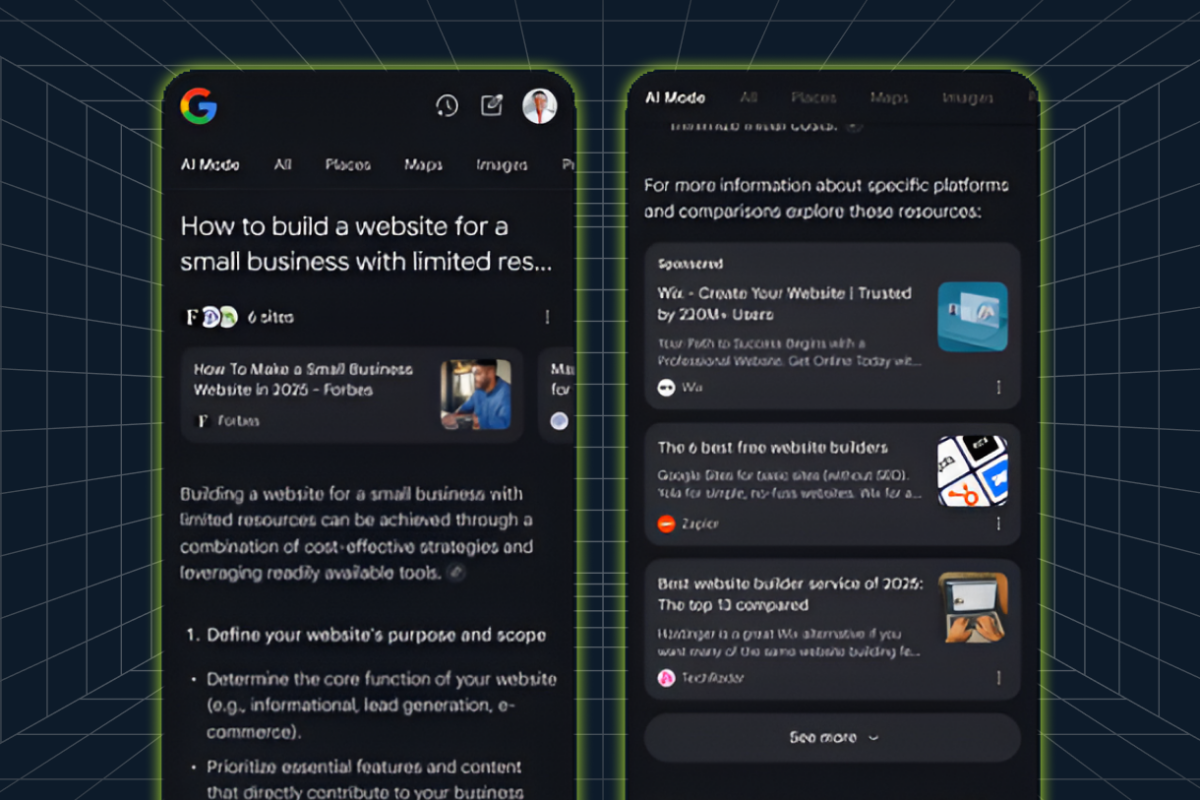
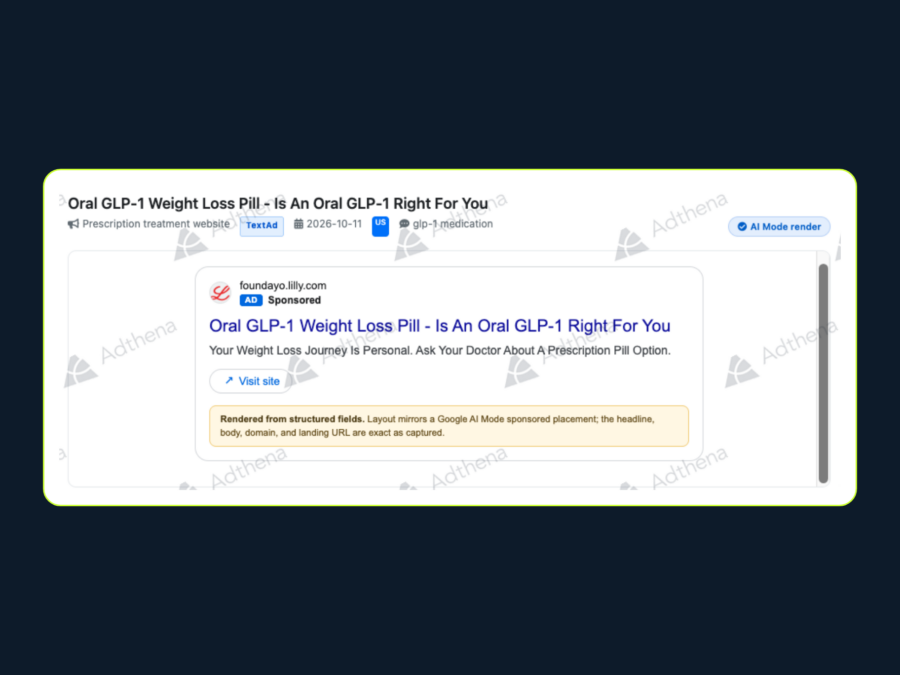
Within Google AI Mode, Product Listing Ads average 85 characters per description vs 54 for sponsored text links, a 57% gap. This is largely because PLA copy serves as product title data pulled from merchant feeds, cramming in specs, model names, and variants. Text ads in AI Mode are concise by design, with most fitting inside two short segments separated by a dash.
- Text ads lean on dashes; PLAs lean on pipes
Sponsored text links in AI Mode average 2.1 copywriting segments per ad, almost exclusively divided by ” – ” (e.g. “T-Mobile® 5G Home Internet – $30/mo with 5-Year Guarantee”). Shopping ads average 2.5 segments and use pipe separators ( | ) at 7× the rate of text ads.
This structural difference hints at the feed-driven, attribute-stacking nature of PLA copy versus the more deliberate headline composition of text ads.
- Shopping ads are number-dense; text ads use numbers sparingly
PLAs contain an average of 3.3 numerical values per ad screen sizes, RAM, storage, processor generations, prices, model years compared to just 1.1 for text ads. A single laptop PLA could contain 10+ numbers (“16″ | Intel Core Ultra 9 275HX 2025 – 32GB Memory – NVIDIA GeForce RTX 5080”). Text ads reserve numbers primarily for price anchoring: $30/mo, $49/month, 40% off.
- Price anchoring is the #1 text ad tactic
56% of sponsored text links in AI Mode include an explicit price, percentage discount, or promotional hook. The Telecom/ISP sector leads this aggressively 52% of ISP text ads display a specific monthly price (e.g. “$20/mo”, “$30/mo”, “$39/mo”), with several committing to multi-year lock-in pricing as a trust signal (“$40/mo For All 5 Years”).
In contrast, shopping ads contain virtually no price language; pricing is handled by the separate price tag rendered by Google’s UI.
- Urgency language is almost exclusively a text ad trait
26% of text ads use urgency or scarcity signals “Limited time!”, “Offer Ends in 1 day”, “Offer ends 3/31”, “Spring Sale” compared to just 5% of PLAs. This asymmetry makes strategic sense: text ads compete on intent and persuasion, while PLA placement is driven by product relevance scoring.
Urgency in AI Mode text ads appears especially prevalent in Travel and Telecom, where time-limited offers are a primary differentiator.
- Social proof is a text-ad weapon, not a PLA one
23% of sponsored text links deploy social proof language “Best”, “Top”, “#1”, “Official”, “Trusted” versus only 2% of PLAs. Examples include “Top 3 Best Internet Providers”, “5 Best Gaming Computers See Top Picks of March 2026”, and “Editors’ Choice 2026”.
In AI Mode, where the AI itself is already positioning as an authority answering the user’s question, ads that echo that authoritative framing may be well-positioned to complement the surrounding content.
- Exact query match is rare — semantic relevance rules
Only 10% of text ads and 8% of PLAs contain the exact search query verbatim. Instead, copy matches the intent of a query for “cheap replacement headlights for car” surfaces ads like “Best Priced Headlight Assembly – Aftermarket Headlight Assembly” and “Buy Replacement Headlights – Low Prices & Fast Shipping”.
This confirms that AI Mode rewards semantic relevance over literal keyword insertion, making over-optimized exact-match copy less critical here than in traditional paid search.
- Sector styles diverge sharply within text ads
There’s no universal AI Mode tone, industry shapes everything:
- Telecom ads are price-forward and feature-specific (“Same-Day WiFi – Fiber-Powered Internet”)
- Travel ads lean into experience and emotion (“All-Inclusive Luxury at Sea”, “Amazing vacations worldwide”)
- Auto parts ads strip everything back to functional clarity (“OEM Auto Parts – Wholesale Prices”)
- Luxury brands (Chanel, REEDS Jewelers) avoid price entirely and anchor purely on brand name and channel (“Order Online – The Official Site”)
Note: B2B (2 ads), luxury fashion, and beauty have very small sample sizes and treat those sector observations as directional only.
- Brand authority vs product benefits: A channel split
Sponsored text links in AI Mode show a clear brand-authority lean: 10% reference “Official”, “Certified”, or “Authorized” language, and recognizable brand names (T-Mobile, Amazon, Verizon, Chanel, CarMax) anchor 30+ ads.
PLAs, by contrast, are almost entirely product-benefit-focused spec-stacking with processor types, RAM, screen sizes, and model numbers. This suggests text ads in AI Mode are functioning as brand reinforcement within the AI-generated answer environment, while PLAs are purely transactional.
- AI Mode selects ads across wildly diverse queries with no obvious copy template
This dataset spans 45 distinct search terms across tech, luxury, auto parts, travel, telecom, fashion, and B2B yet Google’s AI Mode surfaced ads for all of them within a single scrape session. There is no single “AI Mode ad format” emerging: some winning ads are ultra-short (21 chars: “OEM Auto Parts – Wholesale Prices”), others are 150 character spec dumps.
What they share is contextual fit to the AI’s answer, not a specific copy style. And that’s the most practically important finding here: optimizing for AI Mode is primarily a feed quality and bidding strategy challenge, not a copywriting formula challenge. Though tightly structured, specific copy clearly helps the AI match ads to relevant responses.