TL;DR
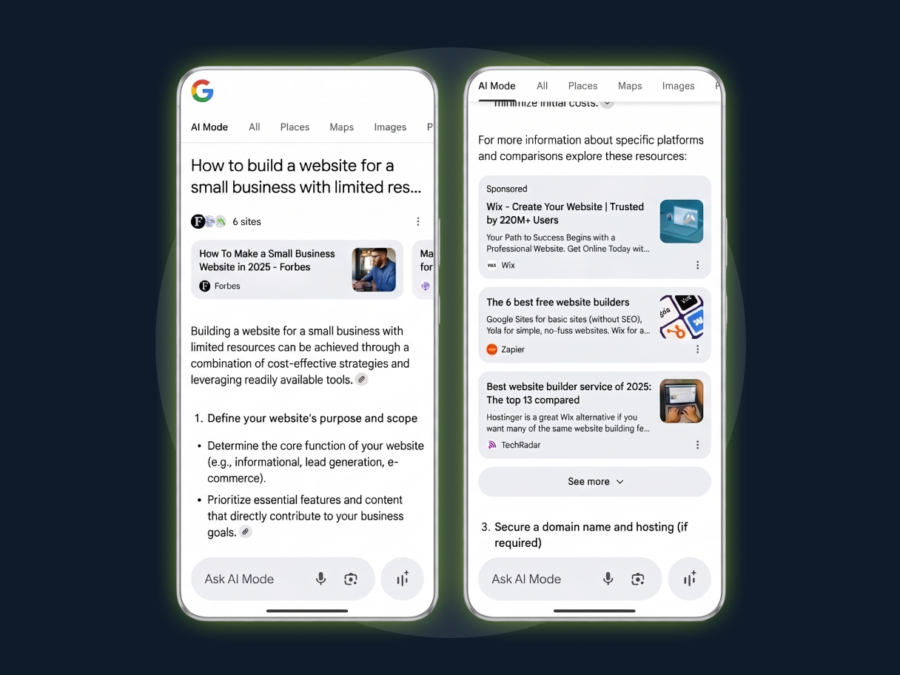
Google I/O 2026 made the agentic Gemini era official. AI Mode now has 1 billion monthly users, AI Overviews 2.5 billion, and Gemini Spark (Google’s first major consumer agent) ships to Ultra subscribers next week. Search is becoming a standing instruction, the SERP is starting to build itself per query, and Gemini 3.5 Flash makes frontier AI structurally cheaper. The surfaces your customer touches are multiplying, the layer between them and your ads is thickening, and the data you need is moving inside Google’s models. GML next week translates this into the ads roadmap.

Published by Joss Froggatt
May 19, 2026
Google I/O wasn’t aimed at advertisers, but little of what was announced leaves paid search untouched. The headlines were Gemini 3.5, a new wave of consumer agents, and a Search experience that adapts to every query. Last year AI Mode and AI Overviews were features Google was testing on advertisers. This year they’re billion-user behaviours, and the agent layer is starting to land underneath them.
Below are the nine announcements that matter most for marketing leaders, with a brief what’s-new and the strategic so-what. Google Marketing Live follows in a few days, and we’ll be back with the ads-specific breakdown then.
1. AI Mode passes 1 billion monthly users. AI Overviews hits 2.5 billion.
What’s new: AI Mode, only a year old, has crossed 1 billion monthly active users. AI Overviews now sits at 2.5 billion. Google says people who use the AI features search more, and that Search “feels more like an ongoing conversation.”
So what: The AI layer isn’t a leading indicator anymore, it’s the dominant search experience. Reporting on impressions and clicks misses what’s happening above the fold. CMOs should be asking where their citations appear in AI Overviews and what share of voice they hold inside AI Mode answers. Our AIO Impact Index puts current AIO frequency at 14% in the US, 20% in the UK and 19% in Australia.
2. Ask YouTube turns video into a search surface
What’s new: Ask YouTube reimagines video discovery. Users ask a question and the experience surfaces the best-matching video, jumping straight to the moment that answers it. Rolling out in the US this summer.
So what: YouTube has always been the world’s second search engine. Now it functions more like Search itself, with users skipping the video shell and landing on the answer moment. For brands with how-to, comparison and product-demo content, it’s a new SERP to measure, and a fresh fight for the answer moment.
3. Gemini Spark: a 24/7 consumer agent
What’s new: Gemini Spark is Google’s first major consumer agent. It runs on dedicated cloud VMs, plugs into third-party tools via MCP, and will operate inside Chrome as an agentic browser later this summer. Beta lands with US Google AI Ultra subscribers next week.
So what: Brief your team on this one. An agent that browses, compares and acts on a user’s behalf changes the economics of attention. The qualified conversation may happen between Spark and a competitor’s product page before a human ever sees a banner. Plan for an early-2027 world where high-intent journeys are agent-mediated. It’s the same logic behind ChatGPT Ads Intelligence and AdBridge: when conversational surfaces hold the conversation, you need to see who’s winning the trigger.
5. Generative UI and custom dashboards in Search
What’s new: Powered by Gemini 3.5 Flash and Google’s Antigravity platform, Search will build dynamic layouts and interactive visuals on the fly for individual queries. For longer-running tasks, it’ll build persistent dashboards the user can return to.
So what: The SERP is no longer a fixed canvas. Two users on the same query may see materially different layouts and sources. Static audits won’t capture what actually surfaces in front of the user. Expect more volatility and a sharper need for market-level intelligence that watches the whole landscape, not just your own clicks.
6. Gemini 3.5 Flash makes frontier AI structurally cheaper
What’s new: Gemini 3.5 Flash beats Gemini 3.1 Pro on nearly all benchmarks, runs roughly four times the output speed of competing frontier models, and costs less than half. Google’s math: a top enterprise shifting 80% of workloads to 3.5 Flash would save more than $1 billion a year.
So what: The cost of running AI inside marketing operations just dropped sharply. Expect a wave of in-house AI tooling from competitors, more agentic experimentation, and tighter unit economics for AI-native challengers. The advantage now comes from data quality and decision velocity, not access to the model.
7. Gemini Omni and the next generative content wave
What’s new: Gemini Omni Flash, the first model in a new Omni family, generates video from any input. It’s live today in the Gemini app, Google Flow and YouTube Shorts. Companion launch: Google Pics, an image-editing tool built on Nano Banana that treats every element as an editable object.
So what: Volume and velocity of generative content is about to step up again. For paid social, YouTube and Shopping, that’s opportunity (test more, faster) and saturation risk (your creative competes with infinite variants). Differentiation moves to brand consistency and creative testing rigour.
8. SynthID Content Credentials goes cross-industry
What’s new: SynthID watermarking now covers more than 100 billion images and videos and 60,000 years of audio. Content Credentials verification is rolling into Search and Chrome. OpenAI, Kakao and Eleven Labs join Nvidia in adopting it.
So what: AI content provenance is moving from research project to platform standard. Within the next year, expect ads and creative to be labelled as AI-generated more often than not. That’s a compliance change for legal and a positioning question for brand. The cross-industry adoption is the real news.
9. Proactive agents inside everyday apps
What’s new: Daily Brief is a new Gemini agent that synthesises inbox, calendar and tasks into one morning digest. Google Flow gains a planning-and-reasoning agent for creative work. Docs Live brings voice-first document creation across Workspace.
So what: The “open the app, decide what to do” moment is being replaced by “the agent already did it.” Email opens, calendar engagement and document-based content marketing all sit downstream of this shift.
The bridge to Google Marketing Live
I/O sets the model and platform direction. Google Marketing Live (GML) translates that into the ads roadmap. This year I/O made the agent the headline character. We’ll be watching GML for the advertiser-side moves:
- Ad surfaces inside AI Mode and the new Information Agents
- Advertiser controls for the generative UI now being built into Search
- Performance Max and Smart Bidding updates running on Gemini 3.5 Flash
- Creative automation tied to Gemini Omni, Google Pics and Flow
- More agent-to-advertiser tooling on the back of Antigravity 2.0
- Smart glasses (audio this fall, display to follow) as a future ambient surface
Final thoughts
The cleanest summary of I/O 2026 for marketing leaders: the surfaces your customer touches are multiplying, the layer between them and your ads is thickening, and the data you need is moving inside Google’s models. The strategic response isn’t more activity. It’s better visibility.
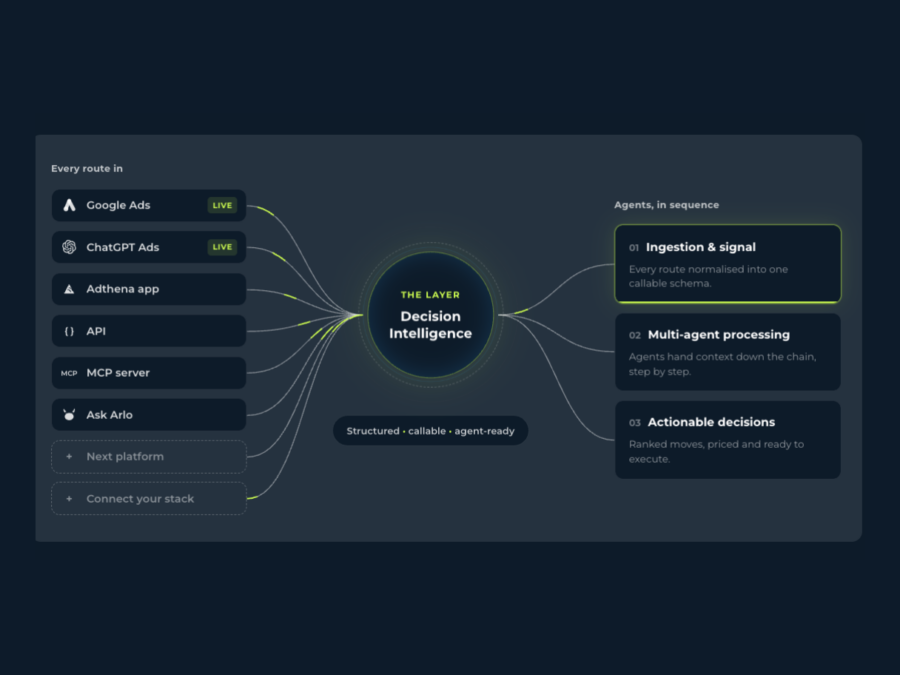
At Adthena, we build the independent intelligence layer for that world. AIO Impact tracks where AI Overviews are eroding or boosting visibility. LLM Rank Tracking and ChatGPT Ads Intelligence cover the answer surfaces beyond Google. Whole Market View shows which competitors are taking share where Google Ads can’t see it. If your team is reshaping the 2026 plan around this shift, we’re happy to walk you through it.
Book a demo with Adthena.