You can’t buy your way into an AI Overview: Here’s what you can do instead

Ads in AIOs | Adthena

TL;DR

AI Overviews now appear on nearly 40% of UK searches, but there’s no switch to target them directly. Eligibility comes down to campaign type, asset quality, and query intent. The sweet spot is 3-4 word queries. Finance, Insurance, and Travel are low-competition now but growing fast. Third-party tools are currently the only way to measure AIO ad performance properly.

Published by Serra Benstead June 23, 2026

When Philip Thune and Neil Patel sat down to discuss the biggest shift in paid search since 2001, one topic kept coming back: the gap between how AI Overviews (AIOs) are being sold to advertisers and how they actually work. The opportunity is real. The mechanics are widely misunderstood.

“We see it working, even if they’re not mentioning you, being in there drives more revenue than not being in there and in most cases you can make it profitable. It makes you money to be in there, if you think otherwise, fire whoever is doing it.”Neil Patel on The Great Search Shift podcast.

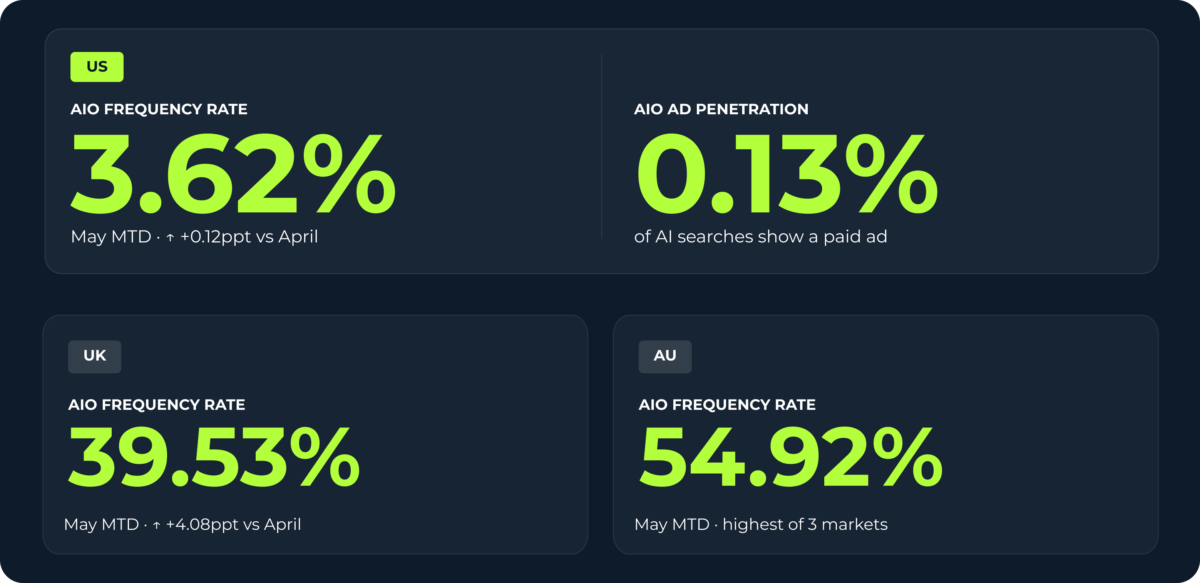
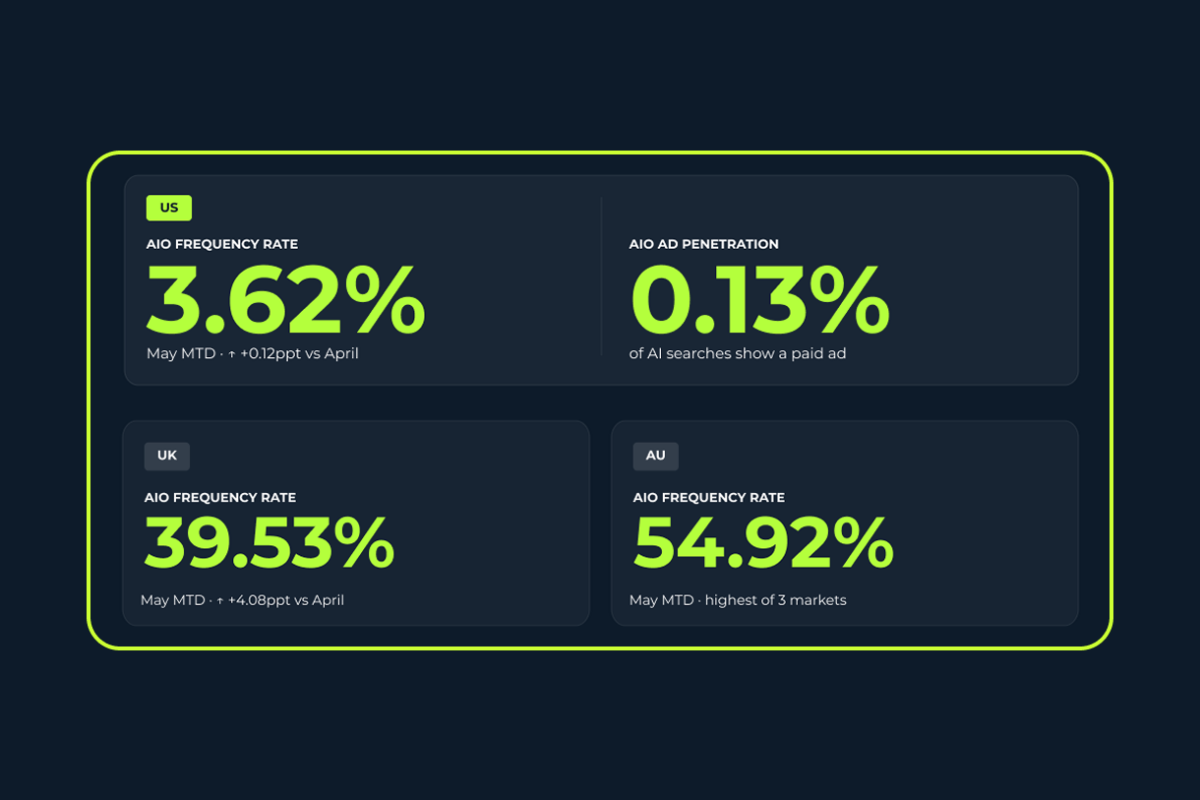
AIOs are now appearing on roughly 1 in 5 UK searches. In May 2026 that number has nearly tripled in eight months, with the UK AIO frequency rate hitting 39.53% month-to-date. For paid search teams, the commercial opportunity looks obvious. But the process of getting ads into that space is not what most people assume.

There is no switch to flip

Most advertisers assume AIO ad placement works like any other Google placement. Find the setting, turn it on, done. There is no such setting.

There is no dedicated AIO campaign type in Google Ads Manager. There is no opt-in toggle, no AIO bid adjustment, no way to say I want my ads here and not there. Google’s systems make that call. What advertisers can control is their eligibility, and whether they have given Google’s AI enough to work with when it does decide to serve an ad.

AIO frequency rate table in the US, UK, AU | AdthenaAdthena UK market data shows AIO frequency has grown from 13.9% in August 2025 to 39.53% by May 2026 (MTD), up from 35.1% in April alone – a +4.08 percentage point jump in a single month. Australia leads all tracked markets at 54.92%. Advertisers who do not understand how eligibility works are already missing placements they do not know they are missing.

How ads actually get into an AIO

If you are running Performance Max or AI Max for Search campaigns, you are already eligible. That is the starting point. Google’s AI then evaluates three things before serving an ad within or around an AIO:

Query intent

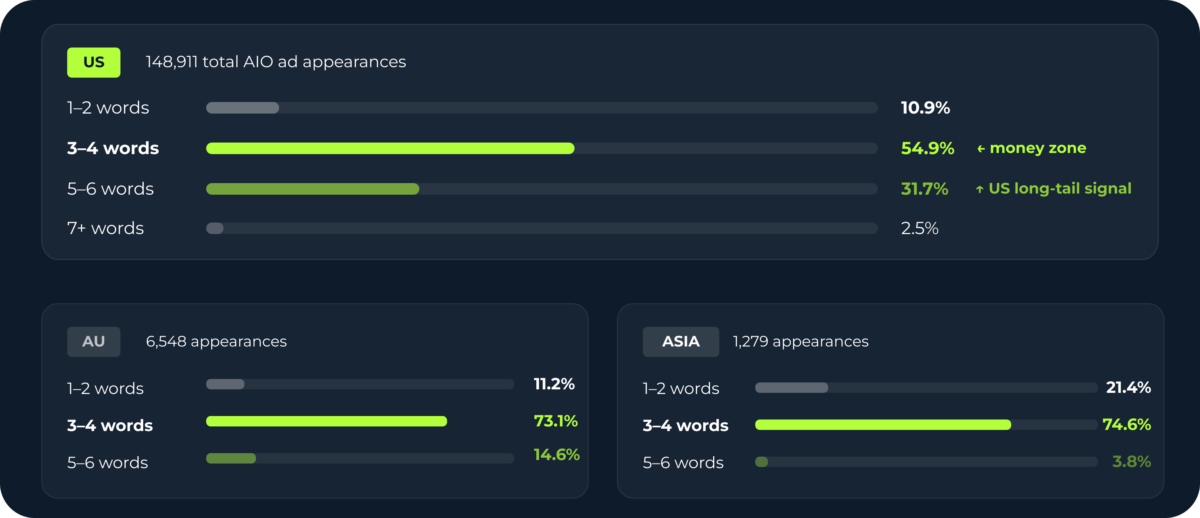
Google classifies whether the query has commercial intent worth serving an ad against. Problem-solving and informational queries dominate AIO triggers. Transactional queries are a much smaller share. Adthena’s May 2026 data shows that 3-4 word queries are the dominant sweet spot for AIO ad appearances globally, accounting for 54.9% of 148,911 total AIO ad appearances in the US, 73.1% in Australia, and 74.6% in Asia.

Critically, the US is already showing a 31.7% signal in 5-6 word queries; a long-tail pattern not yet visible in AU or Asia. This represents an early-mover opportunity for brands willing to bid on longer, intent-rich queries before competition concentrates.

AIO query intent table in the US, AU, Asia | Adthena

Ad and asset quality

Your creative assets, landing page relevance, and Quality Score all feed into whether Google selects your ad. Thin or generic creative is a disadvantage here.

The content of the AIO itself

The AI-generated answer shapes which ads are contextually appropriate. It is matching ads to a context, not just a keyword.

The result is a placement mechanism that rewards relevance and asset quality rather than bid dominance. That is a genuine structural shift from how standard SERP auctions work.

Where ads actually appear

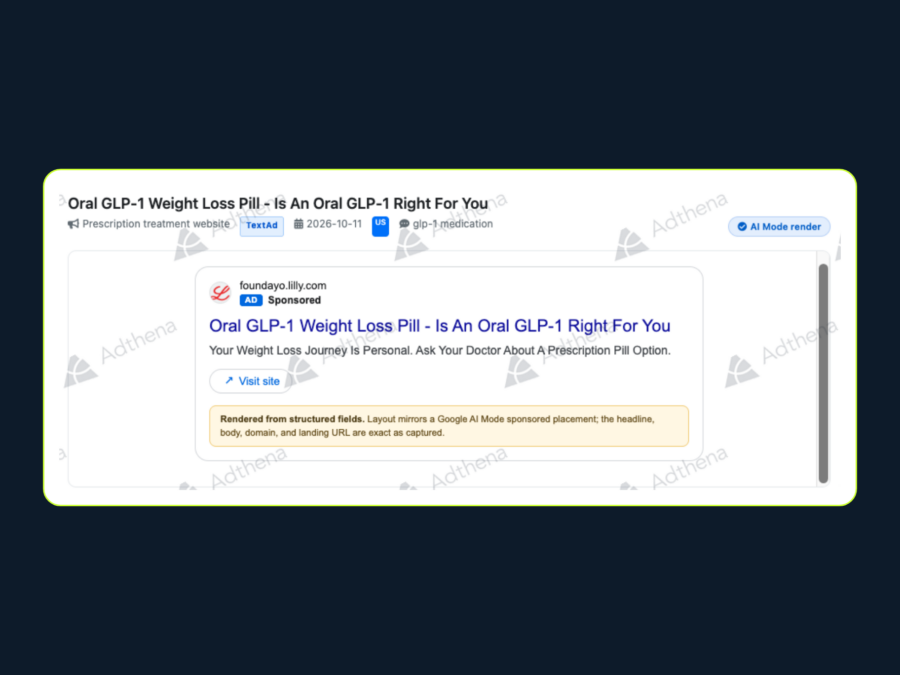
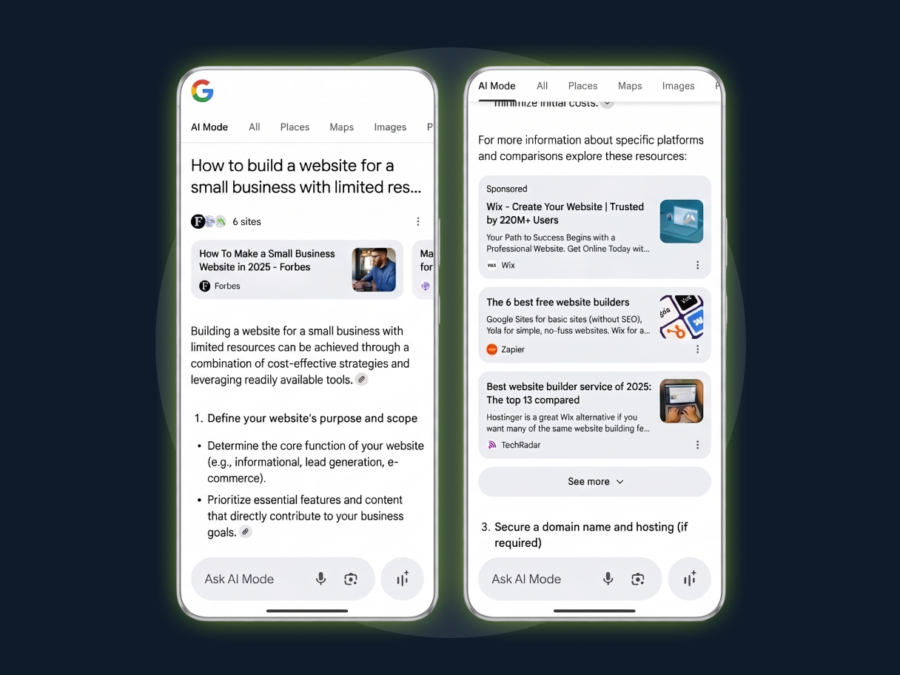
As of early 2026, ads can appear in three positions relative to an AIO: above it, below it, or embedded within the AI-generated text itself.

The above and below placements are available across all 200+ markets where AIOs exist. The within-overview placement is currently live in English in the US, with wider rollout expected through 2026.

Industry AIO exposure: where to act

AIO ad activity is not evenly distributed across sectors. Adthena’s May 2026 data across US, AU, and Asia reveals which industries are already competing and where the white space remains.

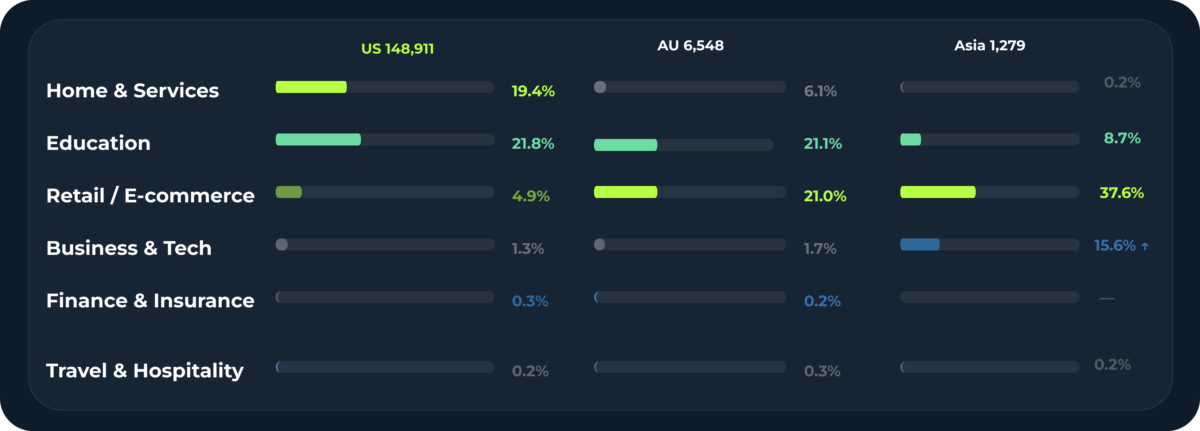
AIO exposure table in the US, AU, and Asia | Adthena

Where does the opportunity lie?

Education is the only sector winning AIO ads consistently across all three markets. Home & Services dominates the US at 19.4%. Retail leads in Asia (37.6%) and is strong in AU (21.0%). Finance & Insurance and Travel & Hospitality show the lowest current volume across all markets, but represent the highest growth potential for early movers.

The settings and levers advertisers actually have

This is where the practical detail matters. While direct placement targeting is not possible, there are several settings that influence whether and how ads appear in AIO contexts.

Campaign type is the entry requirement. Performance Max, AI Max for Search, and Broad Match are currently eligible campaign types. This is the single most important thing to check before anything else.

Search themes tell Google’s AI which query categories are relevant to your business. Setting clear search themes helps steer the system toward the right intent clusters for your ads.

Negative keywords work in AIO contexts the same way they do on standard search. If there are query types where you do not want to appear, negatives still apply.

Brand settings give advertisers some control over how their brand appears in competitive contexts.

Smart Bidding and AIO selection. Google’s automated bidding strategies feed into ad selection across all surfaces, including AIOs. The relationship between Smart Bidding signals and AIO eligibility is not fully transparent.

The control problem

As of today, advertisers cannot directly target AIO placements and cannot opt out of them. Google determines when and where ads appear based on automated signals. That is a meaningful step back in control relative to traditional paid search.

It becomes more problematic when you factor in the reporting gap. Ads served within or adjacent to AIOs are currently reported under Top Ads in Google Ads. There is no segmented reporting that lets you isolate AIO ad performance from standard SERP performance. You are running spend against a new surface with no visibility into how that surface is performing.

The biggest gap is not the ads themselves. It is the visibility. Advertisers are flying partially blind on one of the fastest-growing surfaces in search.

This is likely to change. Google has signalled that dedicated reporting controls are coming as AIO ad inventory matures. But for now, third-party intelligence tools are the only way to get a clear picture of AIO ad frequency and penetration in your market.

What to do right now

Audit your campaign types

Performance Max, AI Max for Search, and Broad Match are the only routes to AIO eligibility. Standard Search campaigns do not currently qualify. This is the first check.

Invest in asset quality

The AI uses your creative assets to judge relevance. Generic headlines and thin descriptions are a disadvantage. More diverse, higher-quality assets give the system more to work with.

Target 3-4 word queries first then push longer 

Adthena’s May 2026 data shows 3–4 word queries are the dominant AIO ad sweet-spot globally (54.9% of US appearances; 73.1% in AU). But the US is already showing a 31.7% signal in 5–6 word queries — an early-mover opportunity AU and Asia have not yet developed. Build your mid-tail foundation now and layer in longer intent-rich queries before the window closes.

Prioritize sectors with proven AIO ad activity 

Education is the safest cross-market bet. If you are in Finance, Insurance, or Travel, you are in a low-competition window with high growth potential. Act before category spend concentrates.

Set clear search themes

These guide Google’s AI toward the query categories that matter to your business. Without them, the system has less signal to work with.

Use negative keywords

They apply in AIO contexts just as they do on standard search.

Monitor AIO frequency for your key terms

Understanding where AIOs are appearing at high frequency is the first step to knowing where your visibility gaps are.

Watch for the reporting update

When Google introduces dedicated AIO reporting, the teams that have already structured their campaigns for AIO eligibility will be best placed to optimize quickly.

The pattern here is familiar

Every major automation shift in paid search has followed the same arc. Google introduces a new surface or bidding mechanism with limited controls. Advertisers who engage early build performance data and optimisation learnings. Controls and reporting improve over time. Advertisers who waited are behind from the start.

We saw it with broad match, Smart Bidding, and Performance Max. AIOs are the next version of the same pattern. The controls are still limited. The reporting is still opaque. But the inventory is live, it is growing fast, and the window for building early-mover advantage is open now.

See exactly where AI Overviews are appearing for your key terms with Adthena’s AIO Dashboard.

Related content