Live orchestrations Enterprise Advertisers are solving today with Decision Intelligence

Decision Intelligence joins your own Google Ads or ChatGPT Ads data to Adthena's Whole Market View™ and turns the combination into a specific next step, not a chart to interpret.

Adthena decision intelligence blog feature image

TL;DR

Decision Intelligence joins your Google Ads or ChatGPT Ads data to Adthena’s Whole Market View, built on over 14 years of labelled paid search data, and returns a specific action instead of another dashboard. This post covers four problems it already solves: a quality score sliding before your CPCs show it, a market shift nobody has connected to your account, non-brand demand your competitors are capturing instead of you, and budget leaking into search terms that never convert. Each one ships today as a client-ready action plan. Decision Intelligence is in Alpha, with early access open through your CSM or AM.


Published by Joss Froggatt September 04, 2026

A dashboard tells you something changed. This tells you what to do

Your CPA just jumped. Was it you, or was it a competitor? Right now, can you actually tell?

For most paid search teams the honest answer is no, at least not quickly, and not with confidence. Every tool you own can see inside your account. None of them can see the market your account competes in. And that missing half of the picture is exactly where the real answers live.

Here’s the problem with every dashboard you’ve ever used: it can tell you a number moved. It can’t tell you a competitor caused it, that the whole market shifted and your position is actually fine, or what to do about either. So the work lands on you, by hand, under time pressure, working blind.

Decision Intelligence starts somewhere no other tool can. It joins your own Google Ads or ChatGPT Ads data, where Adthena has coverage, to Whole Market View, our patented view of the market built on over 14 years of labelled paid search data. Then it does the working out and hands back the answer: which terms to negate, which ad copy to fix, which budget to move, and why. Not a dashboard, not a chart, not a number. An action.
Adthena decision inteligence blog

This is what being the leader in AI search intelligence looks like in practice. Here are some examples of what can be achieved today.

Your quality score is sliding before your CPCs show it

Quality scores drop quietly, campaign by campaign, weeks before the CPC increase shows up on an invoice. By the time it’s visible in the billing, the fix is already overdue.

Decision Intelligence checks a Google Ads account for quality score drops over the past 30 days and shows exactly where: which campaigns, how much the score fell, how many ads are affected, and whether any of the landing pages behind them are broken or outdated. At the same time, it benchmarks the account’s own ad copy against what competitors are actually running, flagging weak wording and stronger angles worth testing, and checks whether AI Overviews (AIOs) are already cutting into that ad’s visibility.

The result is a prioritized list of campaigns to fix first, not a warning after the CPC has already moved.

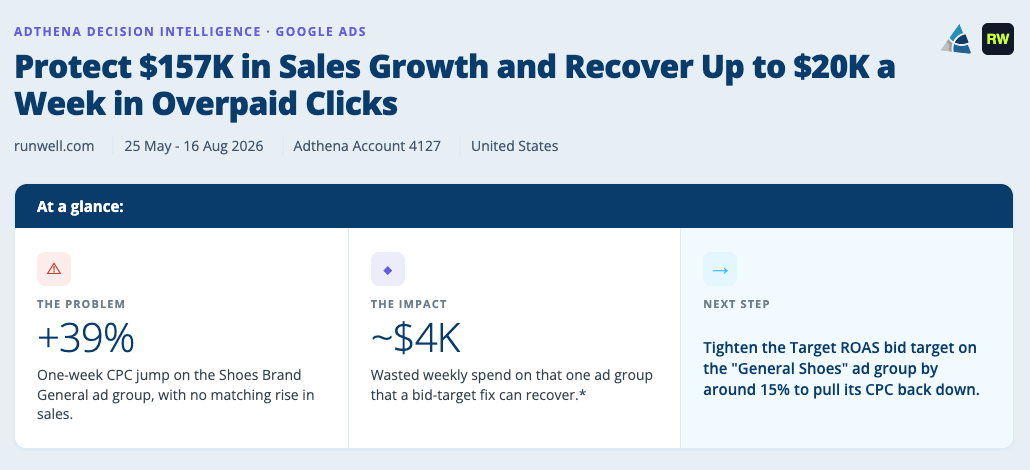
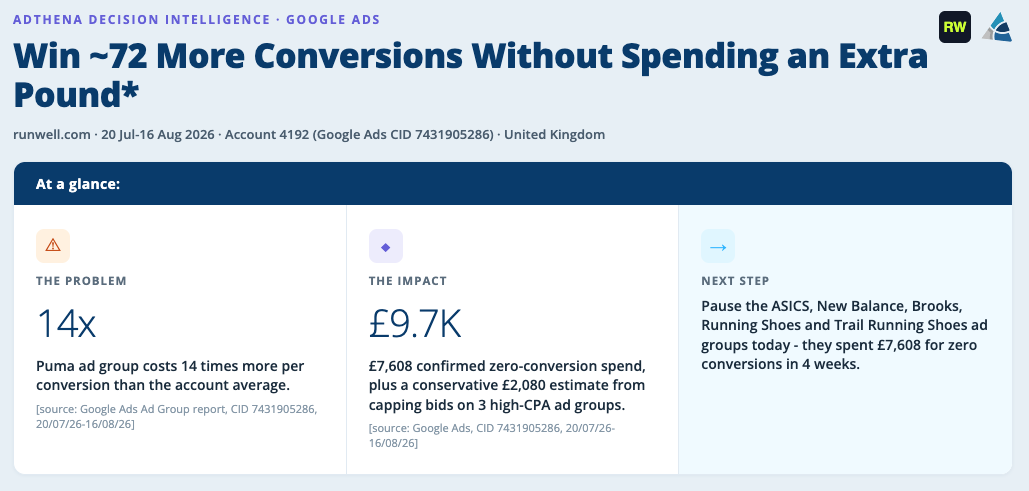
Decision Intelligence report showing a Puma ad group costing 14 times more per conversion than the account average, £9.7K in identified wasted and recoverable spend, and a recommendation to pause five underperforming ad groups A Decision Intelligence report flags a CPC spike with no matching rise in sales, quantifies the wasted spend, and recommends the specific fix to pull costs back down.

The market moved, and nobody connected it to your account

Spend or revenue swings in an account almost always get one of two explanations: the market did something, or something changed internally. Rarely does anyone connect the two with any precision.

Decision Intelligence runs both diagnostics together. It researches market-wide developments for a given topic, drawing on public sentiment, industry news, and financial or corporate moves, while comparing the account’s own performance over two comparable time windows, breaking any revenue change down into impressions, click-through rate, conversion rate, and average order value to isolate which one actually moved. Competitor activity in the relevant market segment is layered on top, so the answer isn’t “revenue dropped.” It’s which part of the funnel dropped, and which competitor move lines up with the timing.

There is demand in your market you are not bidding on

Growth stalls quietly when budget concentrates on brand terms while generic, non-brand demand goes to competitors instead, and there’s rarely a systematic way to see it happening.

Decision Intelligence compares six months of market-wide demand from Whole Market View against an account’s actual non-brand coverage and spend, and returns a shortlist of the highest-value keyword gaps, filtered against a Return on Ad Spend threshold so the list is grounded in what’s actually worth bidding on, not just what has volume. It also checks whether the account already ranks organically or appears in AIOs for those terms, surfacing exactly where visibility is missing across every surface, not paid search alone.

Budget is leaking into clicks that never convert

Negative keyword hygiene is one of the most reliably neglected tasks in a paid search account, and the cost compounds quietly across Search, Shopping, and Performance Max every month it goes undone.

Decision Intelligence compares an account’s own search term footprint in Adthena against its Google Ads search terms report and flags two things at once: terms that are spending with zero conversions, and terms with real demand that the account never picked up. The output isn’t a recommendation to review later. It’s an upload-ready file for Google Ads Editor with the negatives already built, alongside a projected saving over the next 30 days.

A Decision Intelligence report flags an ad group spending 14 times more per conversion than the account average, quantifies the wasted spend, and recommends the ad groups to pause.

A Decision Intelligence report flags an ad group spending 14 times more per conversion than the account average, quantifies the wasted spend, and recommends the ad groups to pause.

Every one of these runs on the same idea

None of the examples above are separate tools. They’re the same underlying idea, applied to four different problems: your own account data, joined to what every other advertiser in your market is doing, run through models built on over 14 years of labelled paid search history.

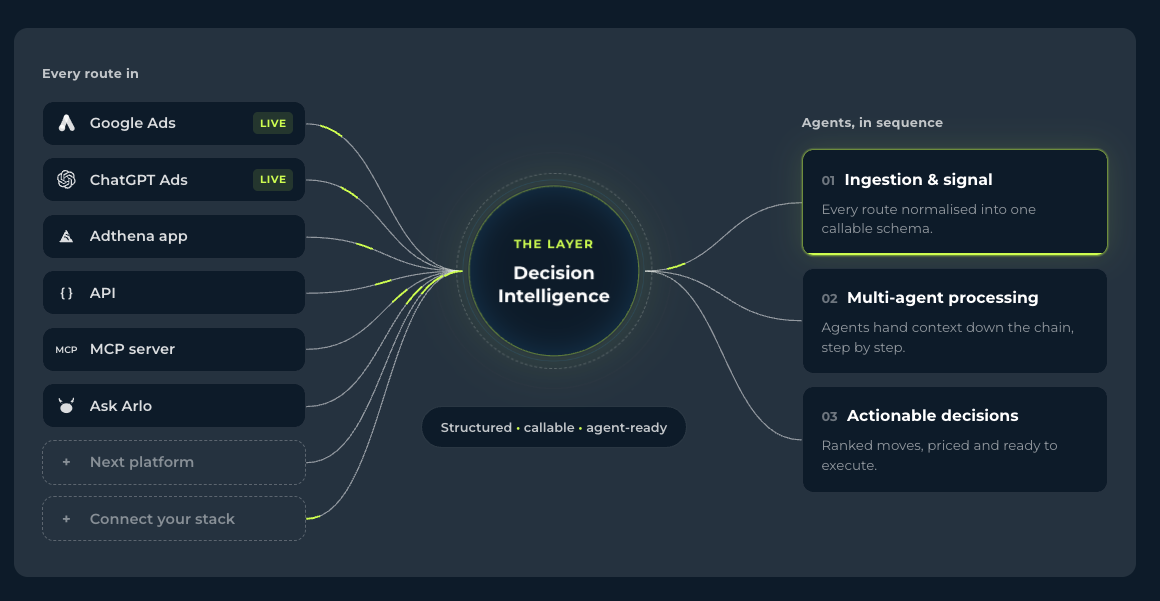
That data is the product. Decision Intelligence is one way to reach it, alongside the app, the API, the Adthena MCP server, and the agents your team is already building. Same data, every route in. And it’s the join that most tools can’t make: a tool that only sees inside your account can tell you a number changed. It can’t tell you a competitor caused it, or that the whole market moved together and your position is actually fine. Decision Intelligence can, because it starts with your account and adds the market on top.

That order matters. You tell us the problem, and Decision Intelligence runs the relevant checks against your own Google Ads or ChatGPT Ads account first, on the platforms and campaigns that matter, so the answer is grounded in what’s actually happening in your spend, not a hunch. Only then does Adthena data go to work on it: the cause, the competitor context, and the action to take.

What's live today, and what's next

Decision Intelligence is in Alpha. Today, each of the four examples above ships as a shareable, editable report or an upload-ready file. The direction of travel is in-app delivery with one-click apply for the recommendations you agree with.

Google Ads and ChatGPT Ads are the early platforms. Adthena already has connections with GA4, Adobe Analytics, Search Console, and SA360. More to come: Microsoft Ads, Amazon Ads, TikTok Ads, LinkedIn Ads, Meta Ads, and Reddit Ads.

Get early access

If you want Decision Intelligence pointed at your own account, talk to your CSM or AM. Access takes minutes to set up.

Talk to us about early access to Decision Intelligence.

Related content