ChatGPT ads vs Google search: Cheaper clicks, harder proof
New Adthena data shows who’s winning ChatGPT ads, what the clicks really cost, and why proving their value is still the hard part.
AIChatGPT
TL;DR
ChatGPT ads can cost far less per click than Google Search, but cheaper clicks don’t guarantee a better return. Adthena’s October 2026 data on six US advertisers shows that Google market leaders often hold a fraction of the ChatGPT ad share, while aggregators move in. With a ChatGPT visit worth roughly a third of a Google visit, clicks need to cost about a third of your Google CPC to break even, and 52% of enterprise brands we spoke to say spend is outrunning return.
Published by Ashley FletcherNovember 11, 2026
ChatGPT ads vs Google search: Who wins the auction before the click
On ChatGPT, comparison and lead-gen sites are taking the ad slots that carriers own on Google. Across the auto insurance prompts we track, aggregators hold 53% of ChatGPT ad placements for one national insurer and 63% for another. On Google, the top three advertisers by clicks in that same market are all carriers.
That gap between who wins Google and who wins ChatGPT is what Adthena set out to measure, using our monitoring of more than 300,000 ChatGPT prompts a day. It also adds context to a study Search Engine Land reported last month, which found ChatGPT ads generated 64% less revenue per visit than Google Search ads ($0.89 against $2.45 in US traffic). That study looks at what happens after the click. We looked at the auction before it, then checked what we found against feedback from more than 30 enterprise brands and agencies, plus the marketers at our AdWorld Experience round table in Bologna.
Key findings
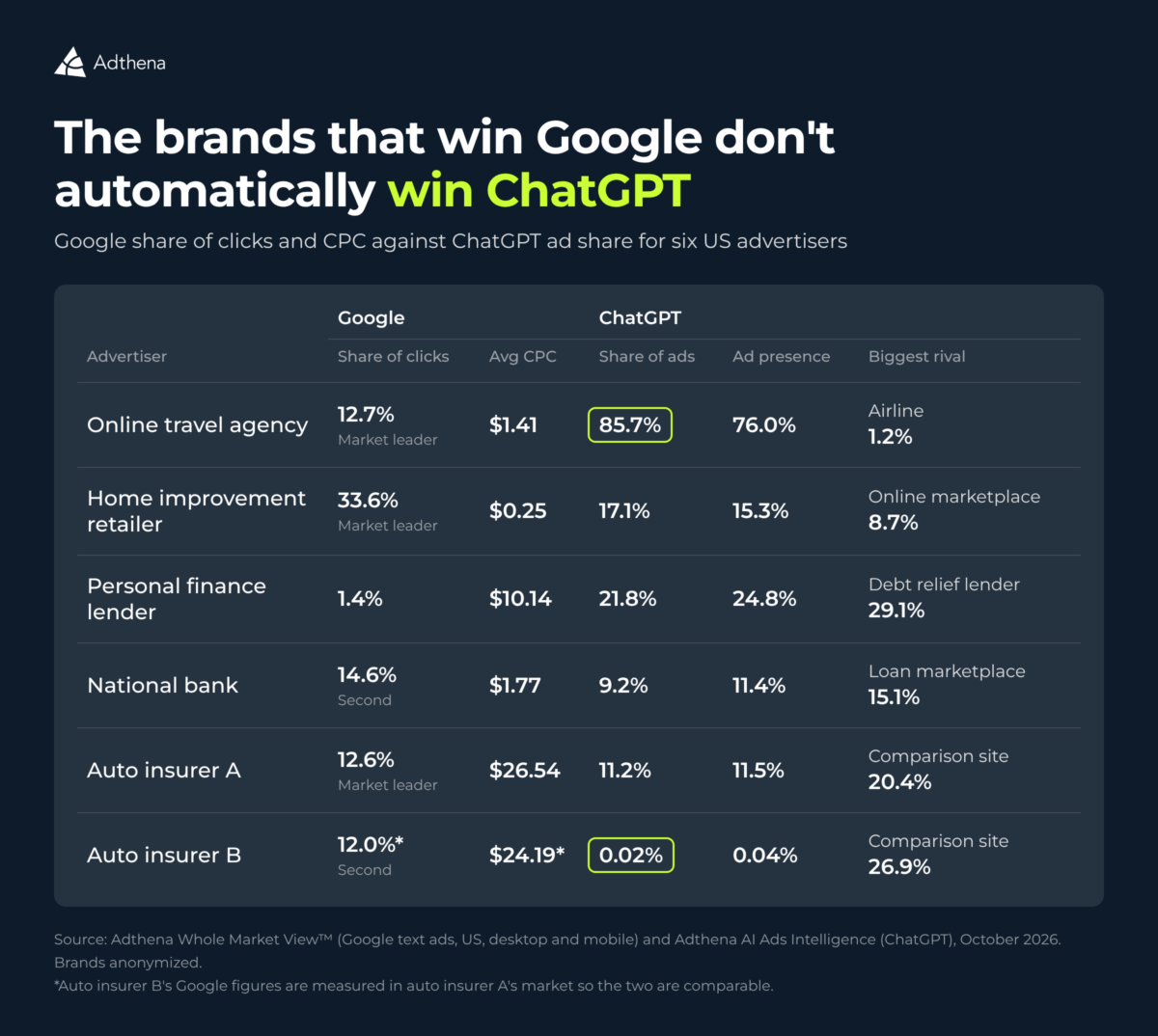
Search leaders lose ground on ChatGPT. A home improvement retailer with 34% of Google ad clicks in its market holds half that share of ChatGPT placements on its tracked prompts.
One of the biggest US auto insurers is close to invisible on ChatGPT ads, with 0.02% share, while its closest rival holds 11 to 13%.
To match Google’s return, a ChatGPT click needs to cost roughly a third of your Google CPC. Some advertisers report paying a quarter, but most we speak to aren’t there yet.
How we ran the analysis
We compared October 2026 data for six US advertisers that track ChatGPT ads with Adthena: an online travel agency, a home improvement retailer, a personal finance lender, a national bank and two national auto insurers, all anonymized. Google figures come from Adthena’s Whole Market View™ (text ads, desktop and mobile) and ChatGPT figures from Adthena AI Ads Intelligence. Each customer configures its own prompt set, so ChatGPT share of ads reflects the conversations that brand cares about rather than the whole category.
The brands that win Google don't automatically win ChatGPT
The travel agency is the exception. Its ads appear in 76% of the answers on its tracked prompts and no rival gets above 2% of placements, which shows what committing to the channel early can buy.
The home improvement retailer tells the more common story. It takes a third of Google clicks at a quarter a click, but on ChatGPT its share halves while marketplaces and specialist retailers take meaningful slices. On 183 of its 1,000 tracked prompts, competitors advertised and it didn’t.
The personal finance lender runs the other way. With about 1% of Google clicks at over $10 each, it’s a small player there, yet it holds more than a fifth of ChatGPT placements on its prompts. For a challenger priced out of Google’s most expensive auctions, ChatGPT is a cheaper way into the conversation.
Comparison sites are taking the ChatGPT ad slots in insurance and finance
On auto insurer A’s tracked prompts, four comparison and lead-gen sites took 53% of ChatGPT ad placements between them, against 11% for the insurer. On insurer B’s prompts, three of those sites took 63%. In the same Google market, the top three advertisers are all carriers, with 32% of clicks between them.
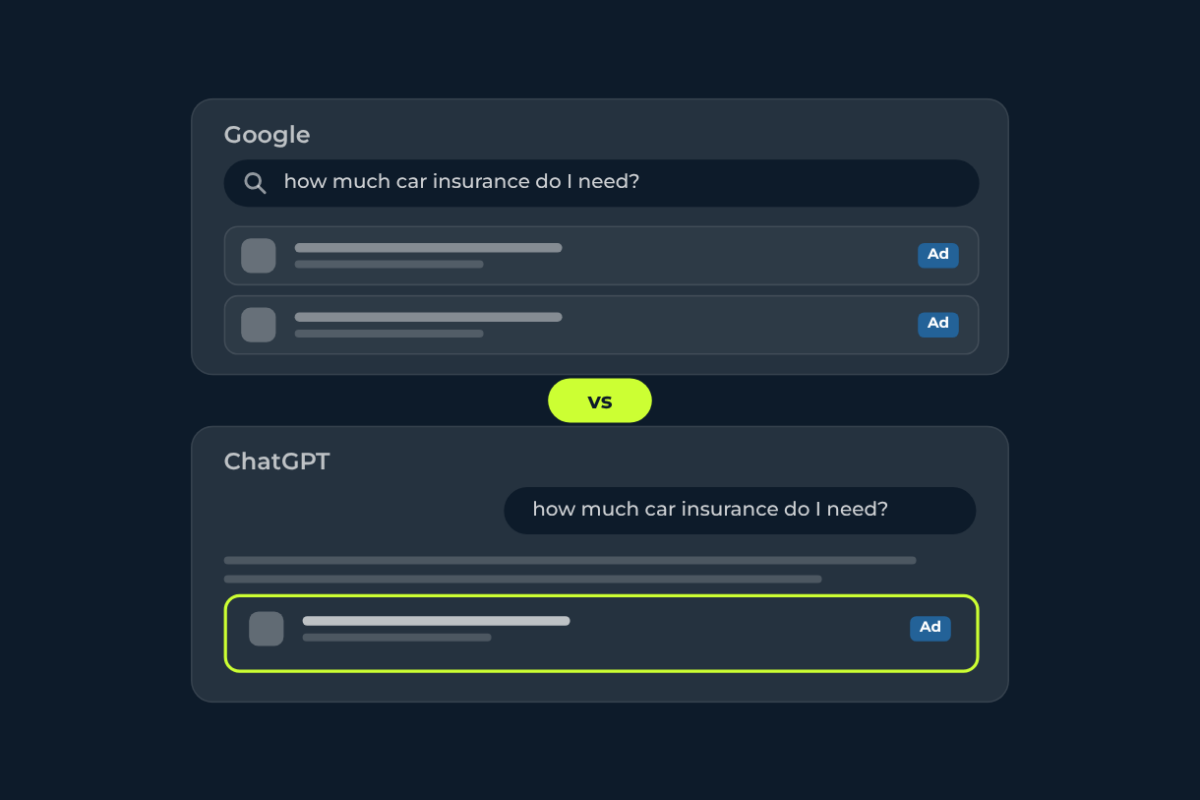
Insurer A is missing from 24 of its 110 tracked prompts where competitors advertise, including “life insurance quotes” and “how much car insurance do I need?”. These are high-intent questions, and on ChatGPT they’re being answered next to someone else’s ad. It’s the risk I raised at AdWorld: brands assume their Google position carries over, and it doesn’t.
ChatGPT clicks are often cheaper, until targeting slips
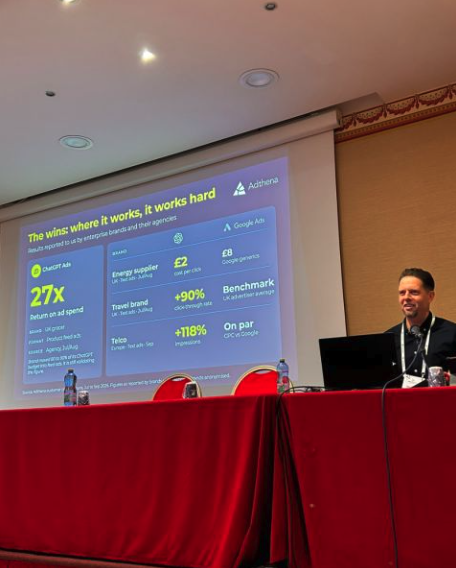
Adthena tracks when competitors enter a prompt category and how that moves auction prices, but CPCs come from the advertisers. What they report suggests ChatGPT can be far cheaper where the auction is still thin. A UK energy supplier pays about £2 a click on ChatGPT text ads against about £8 on Google generics.
Cheap is relative, though. The researchers behind the study estimate that a ChatGPT click would need to cost about $0.26, on average, to match Google Search’s return on ad spend. That’s a blended figure, so the ratio is more useful: with ChatGPT visits worth roughly a third of a Google visit, a click needs to cost roughly a third of your Google CPC. For the home improvement retailer, that’s under a dime. For an auto insurer paying $26, it’s nearer $9. The energy supplier clears that bar, but most advertisers we speak to don’t yet.
Loose targeting is where the savings leak
Without keyword lists or negatives, relevance on ChatGPT comes down to a free-text context hint. A UK mobile network paying about £0.66 a click with its hints set up properly saw its CPC rise 86% in ten days with no change in competitor bidding. A copy-and-paste edit had overwritten the ad group’s hints, costing around £7,100 a month in extra spend and 2,500 fewer clicks a week.
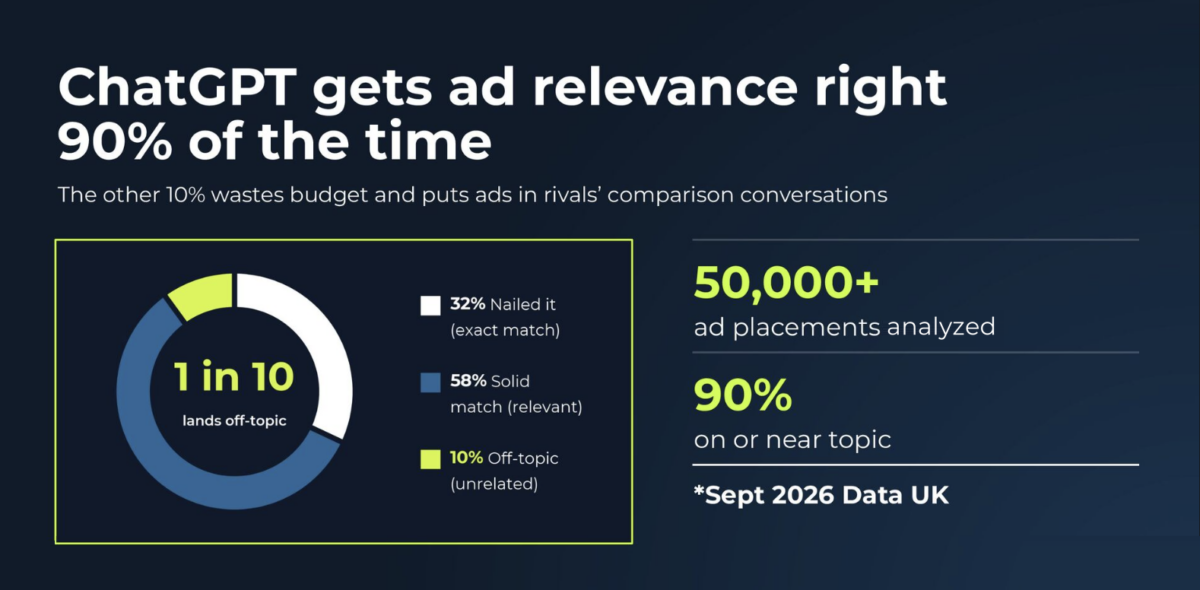
ChatGPT’s own matching is strong. In UK data from September, about 90% of ChatGPT ads landed on or near topic. The other 10% is where budget goes missing: on the home improvement retailer’s prompt “best deck stain for pressure-treated wood”, 26 different advertisers showed ads, including a yacht broker and a credit card comparison site.
Conversion is the part nobody can prove yet
A conversion rate of 0.37% against Google’s 1.17% means a ChatGPT ad visitor is about a third as likely to buy in that session, and our customers’ experience backs that up. Of the 30 enterprise brands that shared ChatGPT ads results with us between July and September, 52% said spend was outrunning return. Another 22% described cheap reach with weak conversion, and 26% said results matched or beat Google. A global asset manager put it neatly: “It performs worse than standard search, but better than standard display.”
The wins are real where the format fits. A UK grocer reports a 27x return on ad spend from product feed ads and has moved most of its ChatGPT budget into them, though it’s still validating the figure.
Measurement problems are more common. A UK retailer counted 198 clicks in the ChatGPT dashboard and six in GA4. A B2B marketer checked around 50 ChatGPT leads in Salesforce and found no pipeline attached to any of them. As a UK insurer put it: “We’re seeing quotes, but not sales.” The study’s window ends in August 2026, before conversion bidding and the pixel arrived, so some of this should improve.
There’s an organic cost to watch too. The same study estimated that unpaid ChatGPT referrals to websites fell 7.2% to 8.4% in the first 13 weeks after ads launched, once adjusted for regional growth. Brands missing from the ad units may lose out twice, which is why ChatGPT planning needs your SEO and paid teams in the same room.
What to do about it
Validate tracking before you scale. Compare in-platform conversions with GA4 and your CRM, and judge the channel on geo split tests and branded search trends rather than last-click CPA.
Audit the conversations about you. Find the comparison and category prompts where competitors and aggregators advertise and you don’t. One finance brand cut intent mismatch by about 20% in two weeks this way.
Write tight context hints and check them often. Keep one idea per ad group, with a line on what it isn’t about. On our own account, this took our ad frequency on comparison prompts from 0% to 22% within days.
Above all, run it as an experiment with a clear budget and clear questions. One attendee in Bologna offered a line for the board that I’ve borrowed since: the budget is putting the brand into brilliant conversations it would otherwise never join. That’s worth something, as long as you can see which conversations they are.
See where you stand
Revenue per visit tells you how a channel performs once someone clicks. Share of ads tells you whether you’re in the answer at all, and who’s there instead. You need both to decide where your next dollar goes.
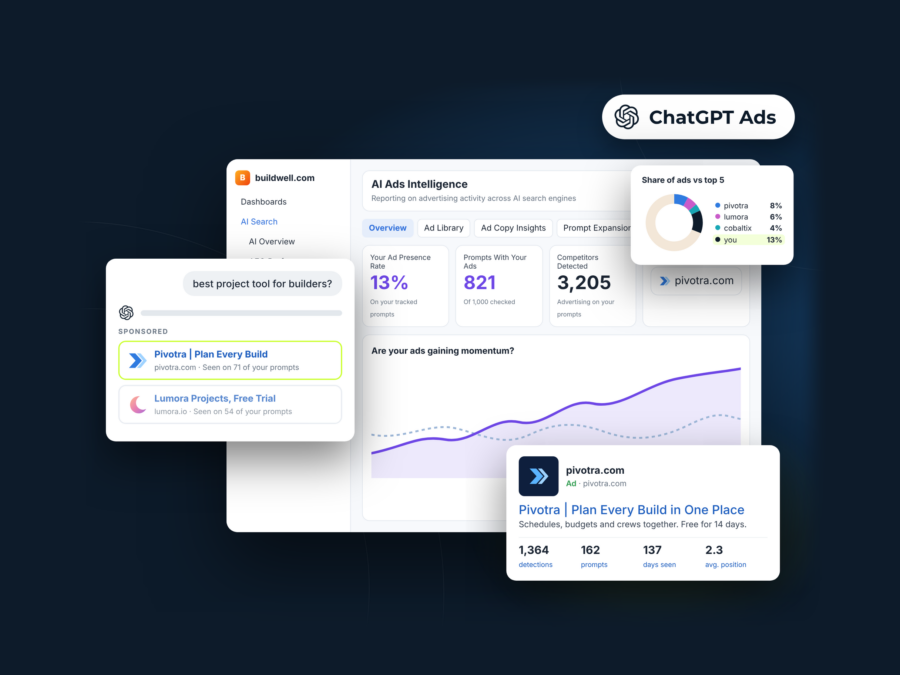
Adthena is the Decision Intelligence platform for your AI search strategy, tracking your ads and your competitors’ across Google, AI Overviews and ChatGPT, where available, from one data layer. Start with our free ChatGPT Ads Share of Search Index to see who’s advertising in your category, or talk to our team about AI Ads Intelligence for your own prompts.