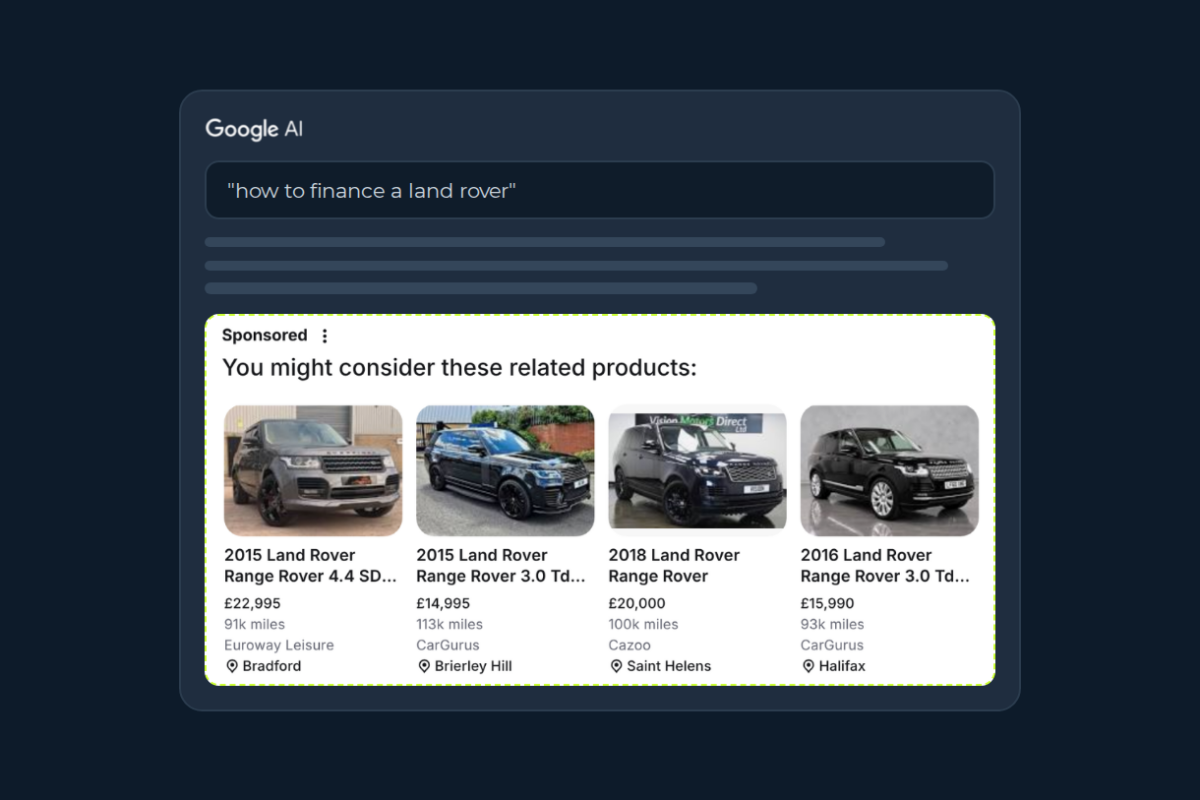
Google AI Mode ads are live in the UK: The first examples

We started tracking UK AI Mode the day after Google’s announcement, and the first sponsored placements were already there.

Google AI Mode ads are live in the UK: the first examples

TL;DR

Google’s AI Mode ads are already live in the UK, just days after Google said they were coming in Q4. Our first examples show ads sitting below the AI answer under a “Sponsored” label, with an AI-written intro line that adapts to what the searcher asked. Some of the ads go to brands the searcher never mentioned, and household names such as Compare the Market, Aviva, EE and TUI are already showing up. Because Google Ads doesn’t report AI Mode as a separate placement, the only way to see where you appear, what your ad says and who sits beside you is to track it from the outside. More data is on the way.

Published by Joss Froggatt November 02, 2026

On October 28, Google announced that ads in AI Mode would expand to more markets, with the UK named for Q4 2026. The next day, we started monitoring commercial prompts in UK AI Mode to catch the first sponsored placements as they arrived.

They didn’t take long. Below are three of the first ads we’ve captured in UK AI Mode, what each one tells us about how the format works, and what advertisers can do about it. There’s a lot more data behind these, from more advertisers and we’ll share the fuller picture soon.

What an AI Mode ad looks like

In each example, the ads sit beneath AI Mode’s answer under a “Sponsored” label. Every ad block opens with a short line of AI-written copy that links the ads back to the conversation, followed by either product-style cards or classic text ads. That intro line is new, and as the examples show, it changes depending on what the searcher asked.

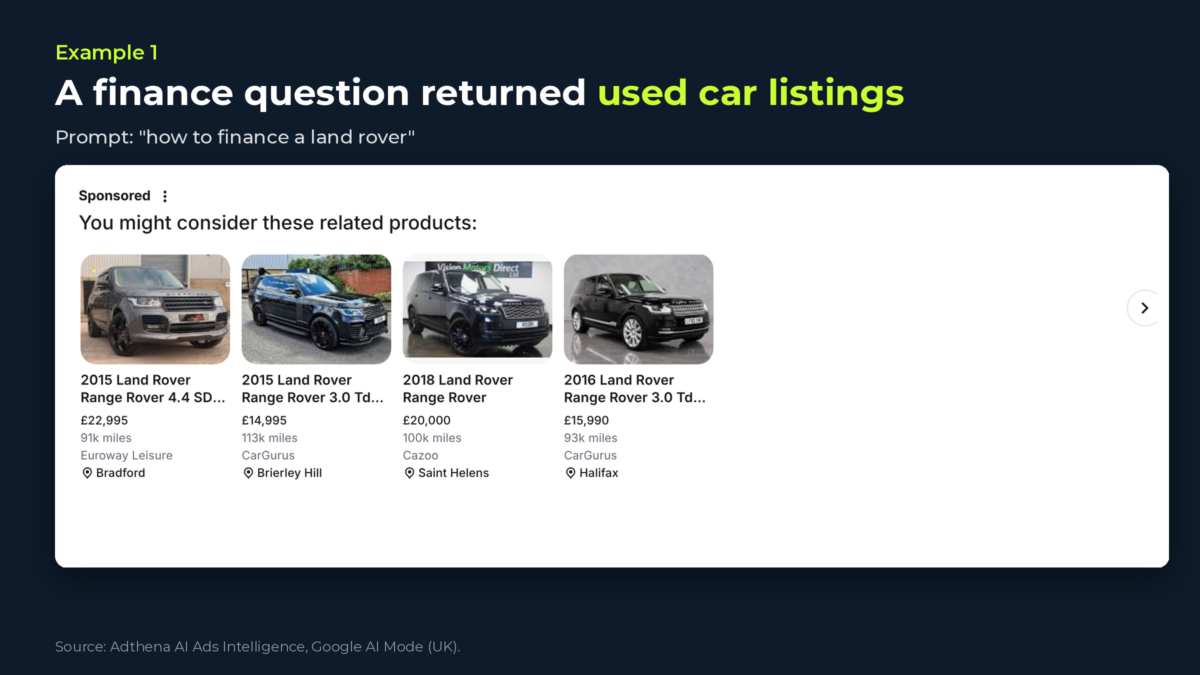
Example 1: A finance question returned car listings

Google AI Mode ad showing used Range Rover listings for a car finance question

Asked “how to finance a land rover,” AI Mode gave a detailed rundown of dealer finance, PCP, hire purchase and personal loans. The ad block underneath carried no finance providers at all. It showed four used Range Rover listings from dealers and car marketplaces, introduced with “You might consider these related products.”

AI Mode appears to have treated the query as interest in the car itself. For dealers, that’s reach into a research question they’d rarely bid on. For lenders and brokers, it’s a placement on their own topic that went to someone else.

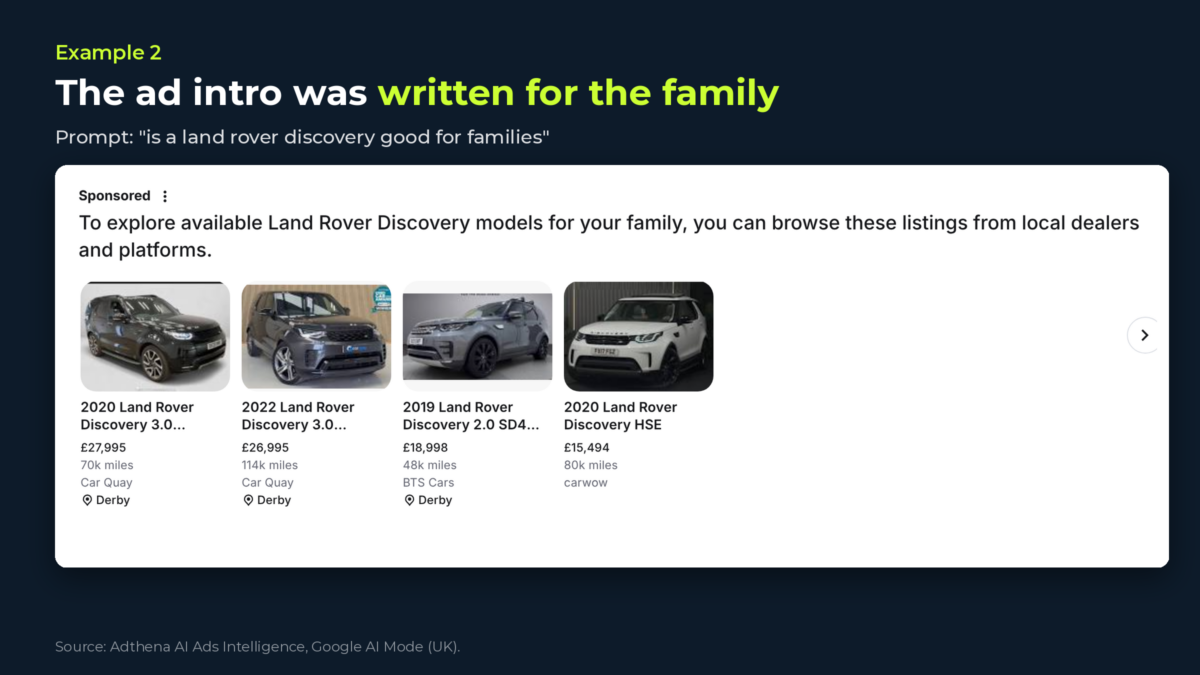
Example 2: The ad intro was written for the searcher

Google AI Mode ad with a family-focused intro above Land Rover Discovery listings

For “is a land rover discovery good for families,” the ad block opened with: “To explore available Land Rover Discovery models for your family, you can browse these listings from local dealers and platforms.” Four Discovery listings followed, three of them from dealers in Derby.

The framing borrows the searcher’s own words. The advertiser didn’t write that line, and they can’t see it in Google Ads, yet it’s the first thing a buyer reads before reaching their listing.

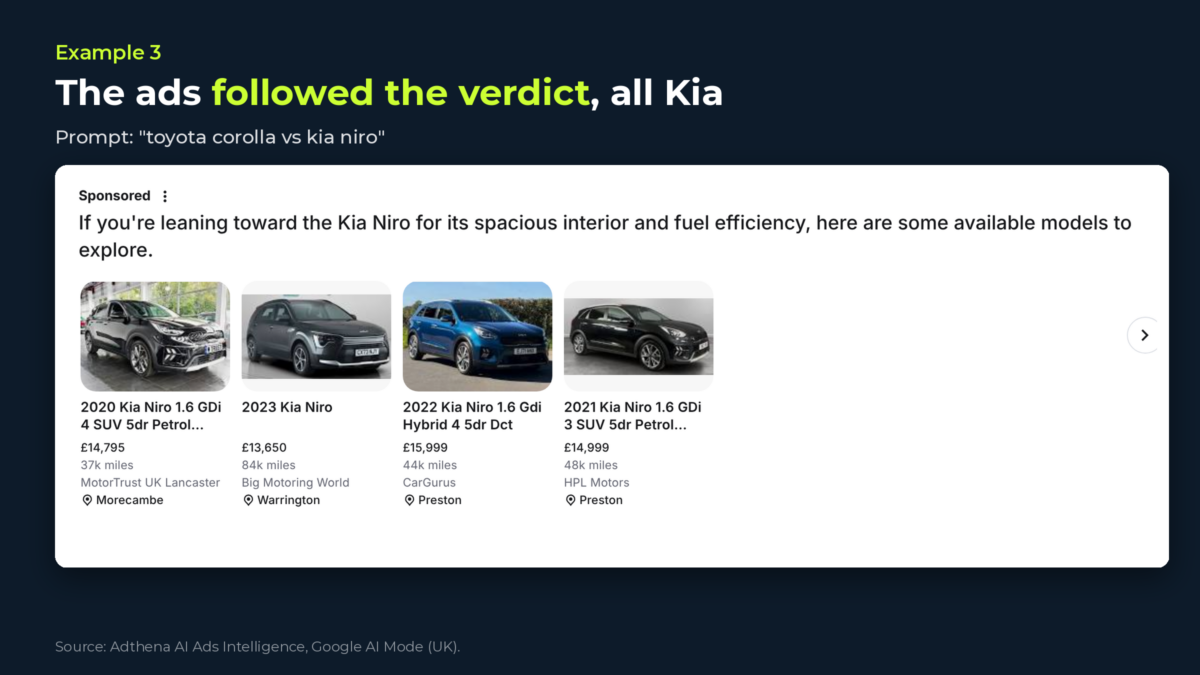
Example 3: The ads followed the answer

Google AI Mode ad showing only Kia Niro listings for a Toyota vs Kia comparison

“toyota corolla vs kia niro” is a classic head-to-head. AI Mode compared the two, then introduced its ads with: “If you’re leaning toward the Kia Niro for its spacious interior and fuel efficiency, here are some available models to explore.” All four listings were Kia Niros. No Toyota appeared in the ad slot.

It’s one example, so we’re careful not to read too much into it. Even so, the ad block seems to have taken its cue from the answer. If that pattern holds, how a brand comes across in the AI response could shape whose ads appear next to it.

Who else is advertising in AI Mode in the UK already?

The early advertisers aren’t niche players testing a new placement. Some of the UK’s best-known brands are already appearing in AI Mode. In comparison and insurance, that includes Compare the Market, MoneySuperMarket, Confused.com, Go.Compare, Aviva and Which?. Santander UK, Starling Bank and Capital One UK are there from banking, alongside EE, Vodafone UK, Virgin Media and Octopus Energy across telecoms and energy. Travel brands are well represented too, from LNER and GWR to TUI, Jet2, easyJet holidays and loveholidays. Retail and home names include Ocado, Screwfix, Moonpig, Selfridges, DFS and Rightmove. Many of them likely didn’t set out to buy AI Mode inventory. Their existing campaigns simply qualified.

How your ads end up in AI Mode

There’s no AI Mode campaign type to opt into. Ads reach the placement through campaigns you may already be running: Search campaigns using broad match or AI Max, Performance Max and Shopping. Google has also been running a small test that lets exact and phrase match keywords serve text ads in AI Mode where intent is explicit.

The ads themselves are built from what you already have. AI Mode draws on your assets, feeds and landing pages, then wraps them in its own intro copy. And Google Ads doesn’t currently break out AI Mode as a separate placement, so you can’t see which prompts you appeared on or how your ad was presented.

From visibility to action

Adthena AI Ads Intelligence tracks ads in Google AI Mode, alongside AI Overviews and ChatGPT where available, showing you the prompts you appear on, the copy that served and who sits alongside you. Here’s what teams can do with that.

Optimize assets and landing pages. Because AI Mode builds ads from your existing assets and pages, seeing the copy it actually serves tells you what to fix at the source.

Close coverage gaps. Spot the prompts where competitors appear and you don’t. That usually points to missing keywords, broad match or AI Max not switched on where it should be, or negatives blocking you.

Clean up relevance. Automated matching also means showing up where you shouldn’t. Prompt-level data shows where your ads appear on irrelevant queries, so you know where to add negatives.

Validate your tests. Turning on broad match, AI Max or Performance Max is often a bet on reaching AI surfaces. Use Adthena data as a baseline before the change and a check afterward to see whether you’re landing in the placement.

More to come

These three examples are the start. We’re tracking UK AI Mode advertising through the rollout and will share a fuller breakdown of formats, categories and advertisers as the data builds. Native platforms show you your own data. Adthena shows you the whole market, then tells you what to do about it.

See which AI Mode prompts your brand and competitors are showing up on. Book a demo of Adthena AI Ads Intelligence.

Related content